What Vegetables Can Cats Eat Safely: Vet-Approved List
YoYour cat is sitting beside you while you prep dinner, watching with the kind of focused attention usually reserved for birds on a windowsill. You are dicing carrots. They look curious. You wonder what vegetables can cats eat without a problem, and which ones should never come anywhere near their bowl?
It is a question worth thinking through carefully. Unlike dogs, who can thrive on a varied omnivorous diet, cats are obligate carnivores, their bodies are wired to run on meat, not plants. But that does not mean every vegetable is off the table. It means vegetables occupy a specific, limited role in a cat’s diet, and understanding that role changes how you think about every vegetable on your cutting board.
For the full picture of every food category not just vegetables, our complete guide to safe and dangerous foods for cats covers fish, meat, fruits, grains, dairy, and more in the same depth.
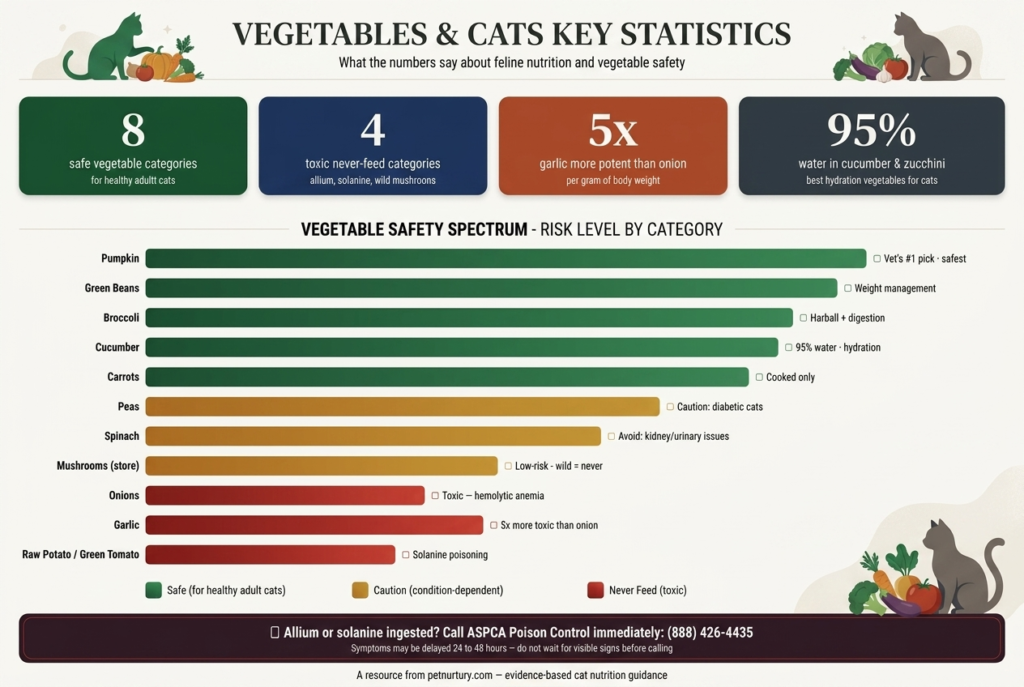
Table of Contents
The Obligate Carnivore’s Relationship With Plants
Cats evolved as hunters. Their livers work differently from ours. They cannot synthesize taurine a critical amino acid for heart and eye health from plant sources. They lack the digestive enzymes to efficiently extract nutrients from carbohydrates. And they cannot convert beta-carotene, the compound that makes carrots orange, into usable Vitamin A the way humans can.
What this means in practice: vegetables cannot fill any nutritional gaps in a cat’s diet. They are not a shortcut to better health, and they are not a substitute for anything. At best, certain vegetables offer specific, limited benefits some fiber, some hydration, some incidental enrichment when offered on top of a complete commercial cat food formulated to AAFCO standards.
The 10% rule governs all of this. Treats, vegetables included, should never account for more than 10% of a cat’s daily caloric intake. For a typical adult cat eating around 200 calories a day, that is a 20-calorie treat budget genuinely small. A thumbnail-sized piece of cooked carrot once or twice a week is the kind of scale we are talking about.
What Vegetables Can Cats Eat? The Safe List
Pumpkin The Veterinarian’s Favorite
If there is one vegetable that appears consistently in veterinary nutrition recommendations, it is pumpkin. Plain, cooked pumpkin or 100% pure canned puree, not pie filling is rich in soluble fiber that works in both directions: it firms loose stools during diarrhea and adds bulk to help things move when a cat is constipated. A teaspoon stirred into wet food is usually enough to make a measurable difference within 24 hours.
The caveat: pumpkin’s effectiveness is tied entirely to its fiber content. The moment seasoning, sugar, or spices enter the picture as in canned pie filling it becomes unsafe. For the full breakdown of how much pumpkin cats can safely eat, which types to choose, and how to serve it, our dedicated guide covers every preparation detail.
Broccoli Fiber With a Side of Hairball Help
Broccoli is safe for cats in small, cooked amounts. Its roughage content supports digestion and may help move ingested hair through the system before it can form a hairball useful for cats who groom heavily. Florets are softer and more digestible than stems; stick to those, steamed thoroughly. Cat owners who want to know exactly how much broccoli is safe, whether stems are acceptable, and which cats should skip it entirely will find the full preparation and safety guide in our broccoli-specific article.
Cucumber and Zucchini Hydration in Solid Form
Both cucumber and zucchini run at around 95% water content, making them two of the most hydrating solid foods a cat can consume. For cats who are finicky drinkers which is common given that cats evolved with a naturally low thirst drive a thin slice of cucumber served correctly or a small piece of cooked zucchini can contribute meaningfully to daily fluid intake. Remove the skin before serving, keep portions small, and expect most cats to show polite indifference.
Carrots Fiber and Vitamin A (With Important Caveats)
Cooked carrots are safe, raw carrots are not. Raw carrots pose a genuine choking hazard and are too hard for cats to digest efficiently. Once steamed or boiled to softness, carrots offer fiber and some Vitamin A though cats absorb beta-carotene poorly, so the nutritional upside is modest. Think of cooked carrots as a low-risk enrichment option rather than a meaningful health supplement.
Peas Plant Protein With a Glycemic Caveat
Peas contain plant-based protein and some immune-supporting micronutrients, and they appear regularly as an ingredient in commercial cat food formulations which speaks to their established safety record.
The portion caveat is especially relevant for cats managing blood sugar: peas sit higher on the glycemic scale than most vegetables on this list, so diabetic cats should avoid them. Our full guide to peas for cats covers portion limits and which cat health conditions change the recommendation.
Spinach Nutritious But Conditional
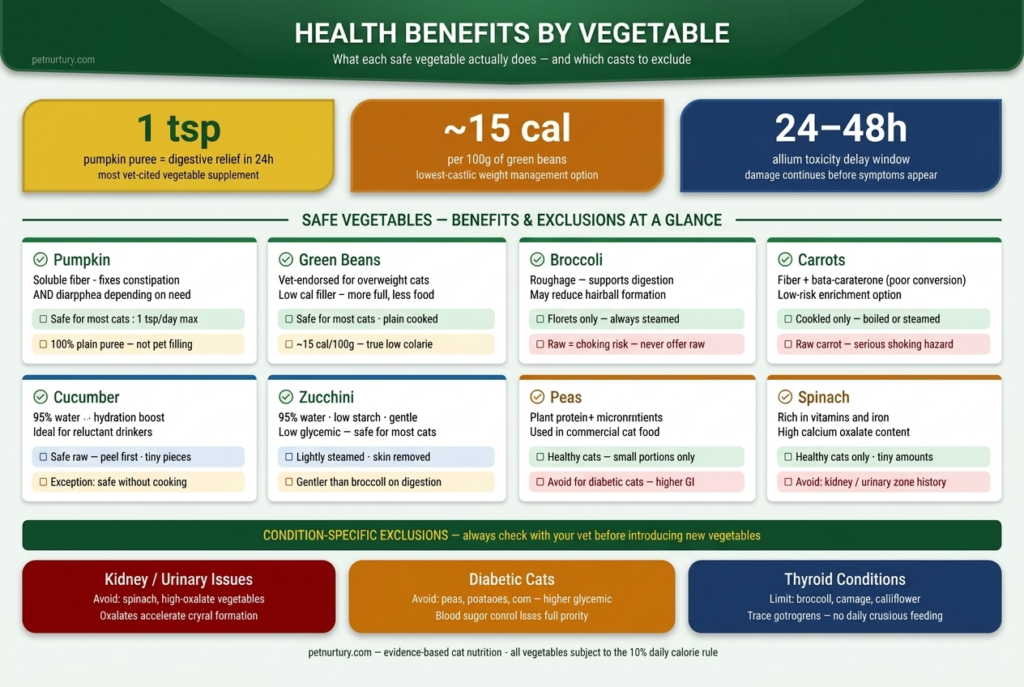
In healthy cats, small amounts of spinach are generally considered safe. It is rich in vitamins and iron. The critical caveat: spinach contains calcium oxalates, which can worsen urinary crystal formation and accelerate kidney stress a detail our complete spinach safety guide for cats covers in full, including which specific conditions make spinach a hard no. Any cat with a history of urinary tract issues or kidney disease should avoid spinach entirely until a veterinarian says otherwise.
Celery
Most cats show little interest in celery, but it is harmless in small amounts its high water content and mild fiber make it a low-risk option for curious cats. Cut it small; the strings can be a texture issue. See our celery and cats safety overview for serving size guidance.
How to Prepare Vegetables for Your Cat
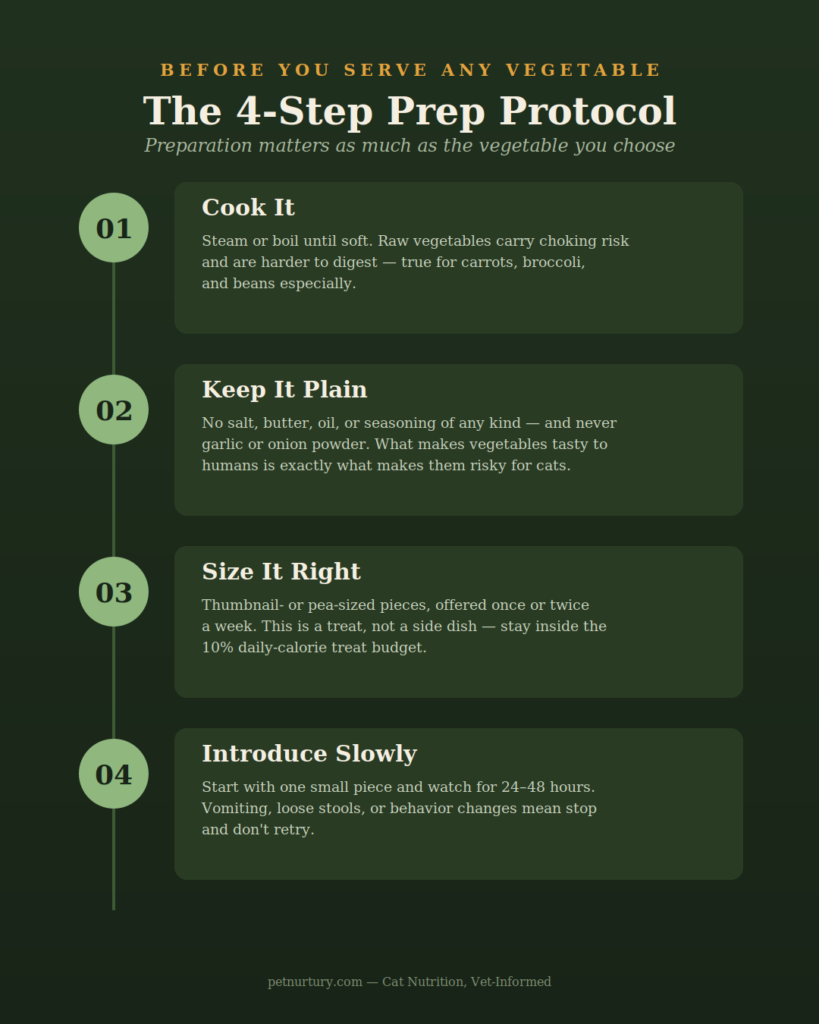
Cook it. Steam or boil until genuinely soft. Raw vegetables carry choking risks and are harder to digest this applies especially to carrots, broccoli, and beans.
Keep it plain. No salt, butter, oil, garlic or onion powder, or seasoning of any kind. The flavors that make vegetables appealing to humans are exactly what create risk for cats.
Size it correctly. Thumbnail-sized or pea-sized pieces, offered once or twice a week. This is a treat, not a side dish.
Introduce slowly. When offering a vegetable for the first time, start with a single small piece and monitor for 24–48 hours. Vomiting, loose stools, or unusual lethargy are signs to stop and not retry.
What Vegetables Can Cats Never Eat? The Toxic List
The Allium Family Onions, Garlic, Chives, and Leeks
This is the most important section on this page, and it applies to every cat regardless of age or health status.
Onions, garlic, chives, and leeks every member of the allium family are toxic to cats. The mechanism is thiosulfate compounds that damage red blood cells, causing hemolytic anemia. What makes this particularly dangerous is that the damage is cumulative: a cat that regularly licks a bowl that held onion-seasoned food, or that gets garlic powder accidentally mixed into a meal, can develop anemia over weeks without any single exposure looking dramatic. By the time symptoms appear pale gums, weakness, labored breathing significant damage has already been done.
All forms carry the same risk: raw, cooked, dried, powdered, and concentrated in broths or sauces. Garlic is approximately five times more potent than onion per gram making it the most dangerous member of the family by weight. There is no safe dose, and no form of preparation makes any allium acceptable for cats.
Raw Potatoes and Green Tomatoes The Solanine Problem
Raw potato contains solanine, a naturally occurring toxin that damages a cat’s nervous and digestive systems. Green or unripe potatoes carry even higher concentrations. Fully cooked, plain white potato flesh is technically low-toxicity, but the solanine risk in raw and green potatoes makes this a vegetable most owners are better off avoiding entirely.
Green tomatoes and all parts of the tomato plant leaves, stems, and unripe fruit contain solanine and tomatine at levels that cause real harm to cats. Ripe tomato flesh is lower-risk but still carries enough uncertainty that leaving it off the list entirely is the more defensible approach for most owners.
Mushrooms
Store-bought culinary mushrooms are generally considered low-risk. Wild mushrooms are a different matter entirely: several species common in North America and Europe are lethally toxic to cats, and distinguishing safe from dangerous varieties requires expertise most owners, and even many veterinarians do not have. Our complete mushroom safety guide for cats breaks down which store-bought varieties are lower-risk and why wild mushrooms are a blanket no regardless of appearance.
Beans A Conditional Caution
Cooked, plain beans in very small amounts are not toxic, but raw or undercooked beans contain lectins that cause digestive upset. Canned beans with added salt, seasoning, or preservatives are a clear no. For cat owners wondering whether any specific bean type is safer than others and what the real risks of raw beans are, our beans guide covers each variety with a clear verdict.
Condition-Specific Cautions
Cats with urinary crystals or kidney disease: Avoid spinach and high-oxalate vegetables. Oxalate compounds can worsen crystal formation and accelerate kidney stress.
Diabetic cats: Be cautious with peas, potatoes, and corn anything higher on the glycemic scale. Blood sugar management takes priority over dietary variety.
Cats with thyroid conditions: Certain cruciferous vegetables broccoli, cabbage, cauliflower contain trace goitrogens that may interfere with thyroid function in quantity. Occasional small amounts are unlikely to cause issues; daily cruciferous feeding is not advisable.
Cats with sensitive digestion: Cruciferous vegetables can cause gas and bloating. If your cat has a history of digestive issues, introduce these slowly, if at all.
If Something Goes Wrong Emergency Protocol
If your cat eats anything from the allium family, an unknown plant, or raw potato, act immediately:
- Remove access to any remaining food
- Note what was eaten, how much, and when
- Do not induce vomiting unless explicitly directed by a veterinarian
- Call your vet or ASPCA Animal Poison Control: (888) 426-4435 (available 24/7)
Watch for: vomiting, drooling, weakness, pale or yellowish gums, labored breathing, or unusual lethargy. Allium toxicity symptoms can be delayed by 24–48 hours do not wait for obvious signs before calling.
Frequently Asked Questions
Can cats eat raw vegetables? Most are not recommended raw. Raw carrots and broccoli pose genuine choking risks, and raw potato contains solanine. Steaming or boiling most vegetables makes them both safer and more digestible.
What is the safest vegetable to start with for a cat that has never had any? Plain pumpkin puree or a small piece of steamed carrot. Both are widely used in feline nutrition contexts and are well-tolerated by most cats.
My cat just ate a piece of onion from my dinner plate. What do I do? Call your veterinarian or the ASPCA Animal Poison Control Center at (888) 426-4435 right away, even if no symptoms are visible yet. Allium toxicity is cumulative and often delayed early action matters.
Can cats eat frozen vegetables? If they are plain (no added salt or seasoning), properly thawed, and cooked through, yes. Never serve frozen vegetables straight from the bag.
Are organic vegetables safer for cats? The organic label changes the pesticide picture but not the underlying safety of the vegetable itself. An organic onion is no less toxic than a conventional one.
Conclusion: A Supplement Not a Substitute
The question of what vegetables cats can eat has a layered answer. Pumpkin, cooked carrots, green beans, cucumber, broccoli, zucchini, and peas offer safe and sometimes genuinely useful additions when prepared correctly and offered sparingly. The allium family, raw potato, green tomatoes, and wild mushrooms belong firmly on the never-feed list.
None of them, however, address any gap that a complete, balanced commercial cat food does not already cover. Vegetables are enrichment at best, and for many cats they will remain curiosities their whole lives, investigated once and then ignored in favor of whatever is actually in the bowl.