What Can Cats Eat Safely: Complete Vet-Approved List
“Can I give my cat a piece of this?” is probably one of the most common thoughts that crosses a cat owner’s mind usually while standing in the kitchen, dinner in hand, with a pair of expectant eyes fixed on the plate.
The honest answer about what can cats eat safely is not one simple question. It branches into a dozen smaller questions depending on what is actually on the plate: a vegetable, a piece of fruit, some fish, a slice of bread, a nut, a sprig of an herb, a bite of cheese, or just a sip from your glass.
This guide organizes the entire topic into the eleven food categories that matter most each explored in enough depth to be genuinely useful, with links to deeper breakdowns for every specific food within each category.
Before diving in, one biological fact applies to every category below and understanding it changes how you read every recommendation on this page.
Table of Contents
The Biological Foundation: Why Cats Are Different
Cats are obligate carnivores. Unlike dogs, who can thrive on a varied omnivorous diet, cats depend almost entirely on nutrients found in animal tissue. Their bodies lack certain digestive enzymes, including the ones needed to break down plant carbohydrates efficiently and they require specific compounds like taurine and arginine that exist only in animal-based food sources.
This single fact explains almost everything you are about to read. It is why some “healthy” human foods offer cats nothing nutritionally. It is why others, despite seeming harmless, can cause real damage. And it is why the safest approach to feeding your cat anything outside their regular diet starts with the same two rules:
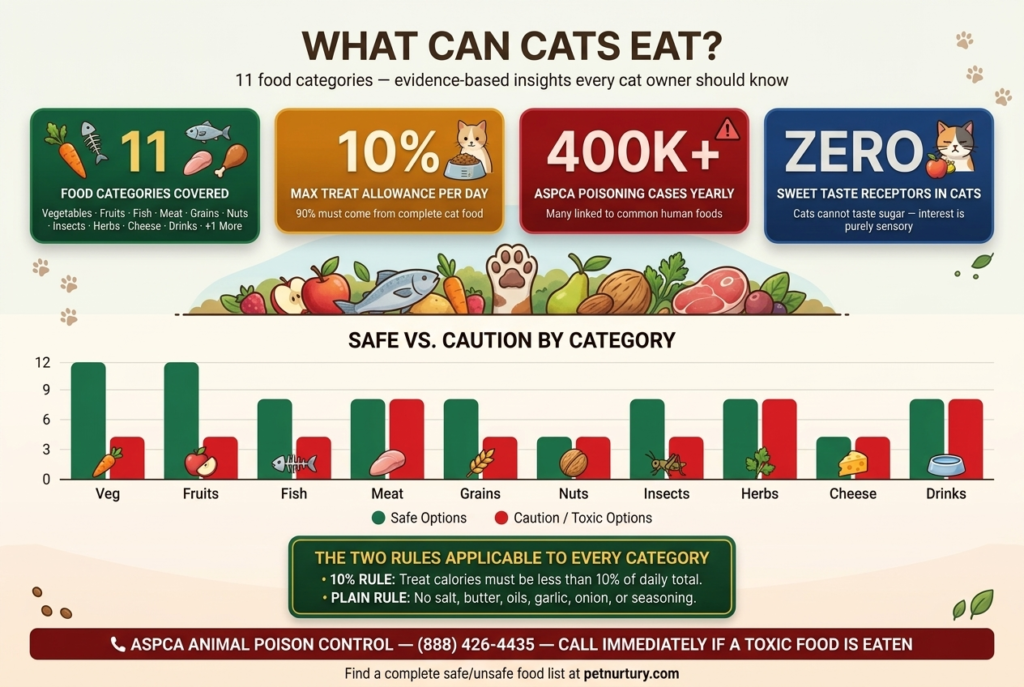
The 10% Rule. Treats and supplemental foods regardless of category should never exceed roughly 10% of a cat’s daily caloric intake. The remaining 90% should come from a complete, balanced commercial cat food formulated to AAFCO standards.
The Plain Rule. Whatever you offer, offer it plain. No salt, butter, oil, garlic, onion, or seasoning of any kind. The cooking method and preparation matter just as much as the food itself.
Vegetables Safe Picks, Hidden Dangers
Vegetables are not a nutritional requirement for an obligate carnivore, but several offer genuine digestive benefits when prepared correctly and a few are dangerous enough to know by name.
Pumpkin is one of the most frequently cited examples in veterinary nutrition: a single teaspoon of plain puree can help regulate both constipation and diarrhea, because its soluble fiber adjusts depending on what the digestive tract needs. Cooked carrots, steamed broccoli, cucumber, green beans, and peas round out the safer options all low-risk when offered plain and cooked.
The other end of the spectrum is the allium family. Onions, garlic, leeks, and chives damage feline red blood cells regardless of whether they are raw, cooked, or powdered and the damage is cumulative, which means a cat can be exposed repeatedly before clinical signs appear. By the time pale gums and weakness show up, significant harm has already been done. The full list of safe and toxic vegetables for cats, including preparation guidance and portion sizes for each safe option, lives in our dedicated vegetable guide.
Fruits Natural But Not Always Safe
Most cat owners are surprised to learn that cats cannot taste sweetness at all they lack the taste receptors for it entirely. When a cat investigates a piece of fruit, the attraction is texture and scent, not flavor. That detail matters because it means the usual assumption “if they like it, it must be okay” does not apply here.
Blueberries, watermelon (seedless, rind removed), strawberries, and cantaloupe are among the safer options in small amounts. Apples and pears work too, but every seed and the core must be removed first, since those parts contain compounds that convert to cyanide. Grapes and raisins sit at the opposite extreme, no safe dose has ever been established, and a single grape can trigger acute kidney failure in a small cat, making it a veterinary emergency regardless of the amount consumed.
Cat owners looking for a complete picture of what fruits are safe versus dangerous for their cat including which preparations are safe, which are not, and exactly what to do if a toxic fruit is eaten will find the full breakdown in our fruit-specific guide.
Fish Close to Natural, But With Caveats
Fish sits closer to a cat’s natural diet than almost anything else on this list, which is part of what makes it worth understanding in detail rather than treating as a blanket yes or no.
Cooked salmon, sardines in spring water, and small amounts of white fish are generally safe in moderation, they deliver omega-3 fatty acids that support skin, coat, and joint health, along with bioavailable protein that suits a carnivore’s digestive system well. The complication is mercury: fish higher on the food chain, especially tuna, accumulate it at levels that become a problem with repeated feeding. Frequency matters more than species in many cases, and raw fish introduces bacterial and parasitic risk that cooking removes entirely.
For cat owners who want to know which fish types are safe, which carry mercury risk, and how often is too often, our fish safety guide covers every common species with specific frequency recommendations.
Meat The Most Appropriate Category
Meat is the single most biologically appropriate category on this list but the word covers a wide range, from plain cooked chicken to raw beef to processed deli products, each with very different risk profiles.
Plain cooked chicken, turkey, and lean beef are the safest options: they mirror what an obligate carnivore is built to eat, and they provide protein in a form the digestive system can use efficiently. Raw meat is a different conversation, bacterial contamination risk is real without careful sourcing and handling, and the raw-feeding debate has genuine arguments on both sides. Processed meats like bacon and pepperoni carry excessive salt and fat that strains kidneys and contributes to weight gain. Cooked bones are a separate hazard entirely: they splinter, and the resulting fragments can cause choking or intestinal perforation.
Cat owners navigating which proteins are safe to feed, how to handle the raw-feeding question, and why certain everyday meats are riskier than they look will find a category-by-category breakdown in our dedicated meat guide.
Grains and Starches Not Needed, Not Always Harmless
Cats have no biological requirement for carbohydrates, which means grains and starches sit outside what their bodies are designed to process but small amounts of the right ones are not harmful.
Plain cooked rice is sometimes recommended by veterinarians as a bland food to help settle mild digestive upset, and plain oatmeal is similarly low-risk in small amounts. The real danger in this category is not rice or oatmeal but raw bread dough: the yeast continues fermenting in the warm environment of a cat’s stomach, producing ethanol and gas in amounts that can be life-threatening. French fries and potato chips belong in the caution zone too, primarily because of the salt and oil rather than the potato itself.
For cat owners wondering whether starchy foods like corn, sweet potatoes, and oatmeal are genuinely harmless or just assumed to be, our grains guide works through every common option with a clear answer for each.
Nuts and Seeds The Xylitol Problem
The real risk in this category is not the nuts themselves, it is what gets added to products made from them.
Plain, unsalted peanuts and most tree nuts in very small quantities are not classified as toxic, though they offer cats nothing nutritionally and carry genuine choking risk. The problem is peanut butter and nut-based spreads: many contain xylitol, an artificial sweetener that causes dangerous blood sugar crashes and liver damage in cats. Xylitol appears in products labeled “natural” or “healthy” that most owners never think to check, which makes it one of the more commonly missed hazards in a cat-proofed kitchen.
Our nuts and seeds safety guide for cat owners identifies which specific products commonly contain xylitol, which nuts carry the highest choking risk by size and texture, and what safer treat alternatives actually provide something useful.
Insects Instinct Versus Risk
This is a behavioral question as much as a nutritional one and it comes up often enough to deserve its own space, particularly for cats who spend time outdoors.
An occasional cricket, moth, or fly is rarely a problem, hunting small insects is instinctive behavior, not a dietary decision that needs intervention. The concern arises with insects that have been exposed to pesticides or insecticides, which carry secondary poisoning risk when ingested. Certain spiders and stinging insects can also cause localized reactions if a cat is bitten or stung in the mouth while investigating.
For cat owners who have noticed repeated insect-eating behavior or are unsure whether a specific bug poses a real risk, our guide to cats and insect behavior distinguishes normal hunting instinct from patterns worth mentioning to a veterinarian.
Herbs From Catnip to Toxic Plants
This category spans a wider safety range than almost any other on this list, which is why a blanket answer in either direction would be misleading.
Catnip, valerian, and small amounts of basil are well-tolerated by most cats, with catnip in particular serving as a genuine source of enrichment and play behavior. The difficulty is that certain common herbs and houseplants carry toxicity ranging from mild gastrointestinal upset to serious systemic effects and visual similarity between safe and unsafe plants is common enough that identification matters more here than in any other category.
Cat owners who grow herbs at home, keep houseplants, or have cats that explore the garden will find the plant-by-plant safety breakdown in our herb guide covering everything from kitchen herbs to common ornamental plants worth bookmarking.
Cheese Common Treat, Common Misconception
Cheese is one of the most frequently offered “harmless” treats and one of the most consistently misunderstood when it comes to what it actually does to a cat’s digestive system.
Most adult cats are lactose intolerant: they lose much of their lactase enzyme production after weaning, which means dairy products cause digestive upset gas, bloating, diarrhea without necessarily showing obvious warning signs first. Caloric density compounds the problem. A small cube of cheddar can represent a disproportionately large share of a small cat’s daily caloric budget, making weight gain a real secondary concern even when the immediate digestive response seems fine.
For cat owners who want to know whether any cheese types are lower-risk, what lactose-free alternatives exist, and what a reasonable occasional portion looks like for cats that tolerate dairy without obvious symptoms, our cheese and dairy guide covers each specific type with honest guidance.
Table Food The Preparation Problem
Table food is the most practically relevant category for everyday life covering finished meals and leftovers rather than single named ingredients.
Plain, unseasoned versions of many prepared foods follow the same logic as their individual components: plain chicken in a pasta dish is still plain chicken, and a bite of plain rice is still plain rice. The risk escalates the moment ingredients become part of a finished dish. Garlic and onion appear in the base of almost every savory sauce. Excessive salt is standard in most prepared food. Rich, fatty preparations stress a cat’s digestive system and pancreas in ways that a single serving may not reveal until it becomes a pattern.
Cat owners who share kitchen space with a curious cat or who regularly find a cat investigating whatever is left on the counter will find our guide to table food, shared meals, and how preparation changes the risk the most practical resource on this page.
Drinks What Goes in the Water Bowl Matters
Hydration is often the last thing cat owners think about when considering diet and one of the first things that affects long-term health outcomes.
Fresh water is the only true necessity, and it should always be available. Cats evolved from desert-dwelling ancestors and have a naturally low thirst drive, which means they frequently do not drink enough water to compensate for a dry-food-heavy diet. The consequences show up most clearly in urinary tract health and kidney function over time. Plain, unsalted bone broth is one of the few additions that can genuinely encourage drinking in reluctant cats. Milk, anything caffeinated, and alcohol belong firmly off the list, dairy causes digestive upset, caffeine causes toxicity, and alcohol causes rapid and serious harm even in small amounts.
Cat owners looking for practical strategies for encouraging a cat who barely drinks and a full breakdown of which beverages are safe versus dangerous will find both in our dedicated drinks guide.
Quick Reference All 11 Categories at a Glance
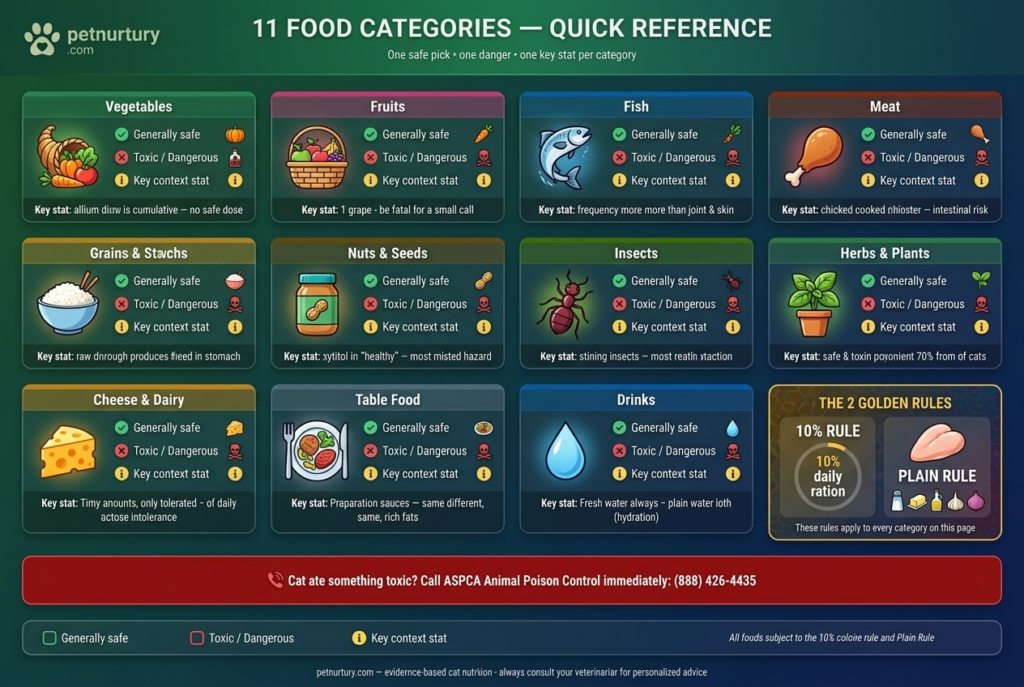
| Category | Generally Safe | Watch Out For |
|---|---|---|
| Vegetables | Carrots, pumpkin, green beans | Onions, garlic (allium, toxic in any form) |
| Fruits | Blueberries, watermelon, cantaloupe | Grapes, raisins (kidney failure risk) |
| Fish | Salmon, sardines in water | Raw fish, frequent tuna (mercury) |
| Meat | Cooked chicken, turkey, lean beef | Raw meat, cooked bones, processed meats |
| Grains | Plain rice, oatmeal | Raw bread dough (life-threatening) |
| Nuts | Plain peanuts (tiny amounts) | Xylitol in peanut butter products |
| Insects | Occasional caught insects | Pesticide-exposed bugs |
| Herbs | Catnip, basil, valerian | Toxic houseplants and garden plants |
| Cheese | Small amounts, if tolerated | Lactose intolerance, caloric density |
| Table Food | Plain unseasoned ingredients | Sauced dishes, garlic/onion, high salt |
| Drinks | Fresh water, plain broth | Milk, caffeine, alcohol |
Frequently Asked Questions
What human food can cats eat every day without any risk? Realistically, none should become a daily habit, even safe foods belong within the 10% treat allowance. A thumbnail-sized piece of plain cooked chicken is among the safer consistent additions if you want to include something every day.
What is a good cat food substitute in an emergency? Plain cooked chicken breast or plain cooked white fish can cover a meal or two, though neither is nutritionally complete for ongoing use without commercial cat food alongside.
Is it ever okay to feed a cat exclusively human food? No. None of the categories above are designed to replace a complete and balanced commercial cat food. They are additions, not foundations, and no combination of human foods provides the taurine, arginine, and other nutrients cats require in the right ratios.
My cat ate something from the dangerous list what should I do? Contact your veterinarian or the ASPCA Animal Poison Control Center at (888) 426-4435 immediately. Do not wait for symptoms several toxic reactions, particularly from alliums and grapes, are delayed by hours and worsen significantly without early treatment.
Can cats eat the same safe food every day? Even safe human foods should remain occasional additions rather than daily staples. Nutritional completeness comes from quality commercial cat food, not repeated additions of any single human ingredient even a safe one.
Is grain-free cat food actually better for cats? Not necessarily. Grain-free describes one ingredient category, not overall nutritional quality. Many grain-free formulas substitute other starches with comparable carbohydrate loads. AAFCO compliance and protein source quality matter considerably more than any single marketing claim.
Conclusion: One Hub, Eleven Paths Forward
The question of what cats can eat was never going to have a one-paragraph answer and it should not. Each category above carries its own logic, its own safe choices, and its own specific dangers worth knowing by name rather than by vague caution.
Use this page as your starting point. Whichever category brought you here today a vegetable on your cutting board, a fish dinner your cat is circling, a curious cat eyeing your cheese plate the guide linked in each section covers the full depth of that specific topic, from preparation and portion size to the handful of items that belong nowhere near your cat’s bowl.