
Can Cats Eat Celery? Benefits, Risks & Serving Guide
If you’ve ever snapped a stalk of celery in the kitchen and had your cat suddenly appear, curious about the sound and the smell, you’re not imagining a random coincidence.
Can cats eat celery? Yes, it’s considered non-toxic and safe as an occasional treat, and the ASPCA lists it as one of the garden staples pet owners can share with their cats without concern.
That said, cats are obligate carnivores. Their bodies are built to run on animal-based protein, and their digestive systems aren’t especially well suited to processing plant material in any real quantity.
Celery isn’t a nutritional requirement for a cat, it’s a supplement, and a fairly minor one at that. But it’s a genuinely safe one, which puts it in decent company among what vegetables can cats eat without much worry.
Table of Contents
Why Some Cats Go a Little Silly for Celery
Here’s a detail that surprises a lot of owners: celery doesn’t contain nepetalactone, the compound responsible for the classic catnip reaction. But it does contain a different compound, lactone sedanolid, and in some cats that’s enough to trigger a similar response, rolling around, rubbing against the stalk, or vocalizing like something exciting just happened.
Not every cat reacts this way, and plenty are simply drawn to the crunch or the aromatic scent instead. If your cat gets weirdly theatrical about a piece of celery, that’s a real, documented phenomenon, not just a quirky personality trait.
The Real Nutritional Case for Celery
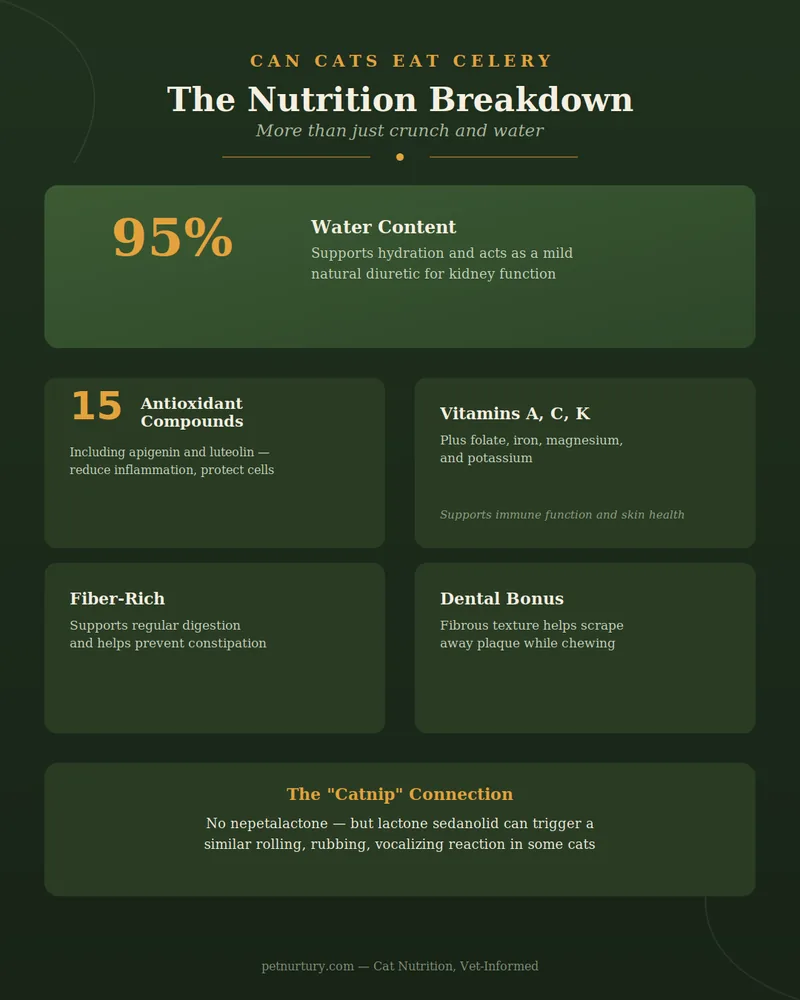
Hydration. Celery is about 95% water, which makes it a genuinely useful way to support hydration, particularly for cats who don’t drink enough on their own. It also acts as a mild natural diuretic, which can be a helpful supporting factor for kidney function, though it’s not a substitute for anything your vet has already prescribed.
Digestive support. The fiber content helps keep things moving, supporting regular bowel movements and helping prevent occasional constipation.
Vitamins and minerals. Celery brings vitamins A, C, and K to the table, along with folate, iron, magnesium, and potassium, a solid supporting cast for immune function and skin health, even in the small quantities a cat would realistically eat.
Antioxidants. Celery contains roughly 15 different antioxidant compounds, including apigenin and luteolin, both of which help reduce inflammation and protect cells from oxidative damage over time.
Dental benefit. The fibrous texture does some quiet work as a cat chews, helping scrape away plaque in a way that’s more incidental than a real substitute for dental care, but useful nonetheless.
The Real Risk: It’s Stringy
Celery’s fibrous strings are the main safety concern here. Swallowed in large pieces, they can pose a choking hazard or cause digestive upset. The fix is simple but non-negotiable:
- Wash thoroughly to remove pesticide residue.
- Remove the tough strings before serving, this is the step most owners skip and shouldn’t.
- Cut into bite-sized pieces, no larger than a teaspoon.
What Never Belongs Anywhere Near Your Cat’s Celery
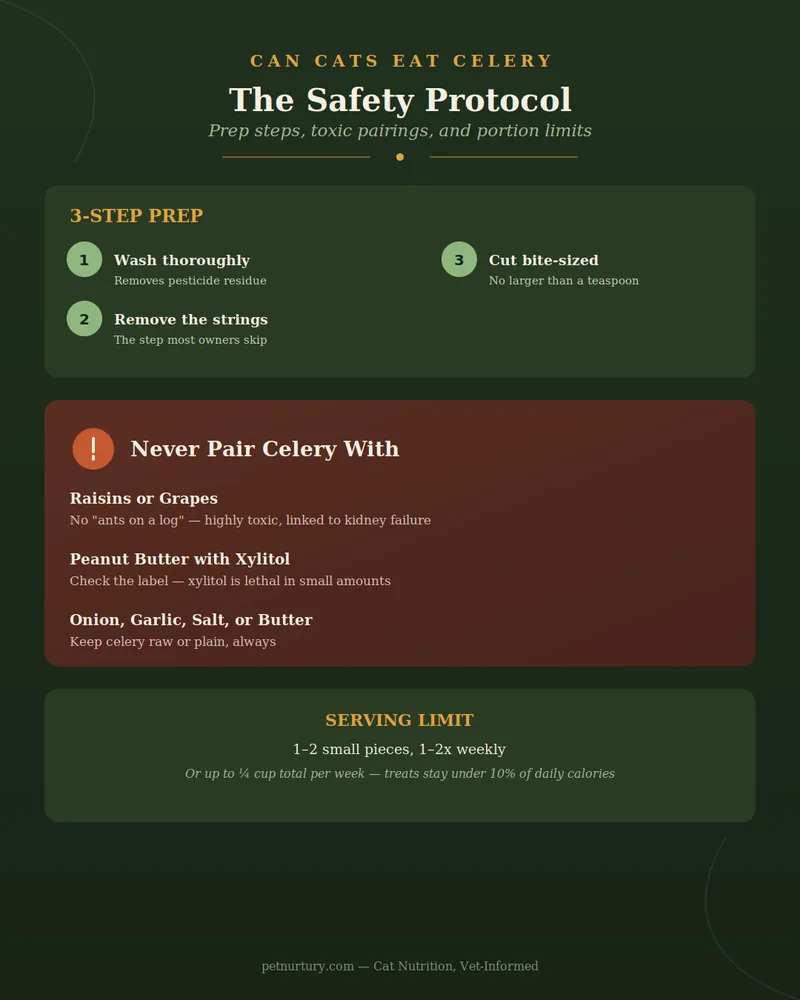
Raisins and grapes. Never make a feline version of “ants on a log.” Both are highly toxic to cats and linked to acute kidney failure, this pairing is genuinely dangerous, not just inappropriate.
Peanut butter with xylitol. If you’re tempted to add a smear of peanut butter, check the label first. Xylitol is a common sweetener in reduced-sugar peanut butter and it’s lethal to pets in small amounts.
Any seasoning. Celery cooked with onion, garlic, salt, or butter should never reach your cat’s bowl. Keep their portion raw or plain, and separate from anything you’ve seasoned for yourself.
How Much and How Often
Celery fits into the same 90/10 framework that governs most cat treats: at least 90% of daily calories should come from complete, balanced cat food, with treats, celery included, making up no more than 10%. In practice, that means one to two small pieces, one to two times a week, or roughly a quarter cup spread across a full week at most.
After the first try, watch your cat for 24 hours. Diarrhea, vomiting, or any swelling are signs to stop and check in with your vet, uncommon with celery, but worth knowing regardless.
Other Forms of Celery Worth Knowing About
| Form | Safe for Cats? | Notes |
|---|---|---|
| Celery stalk (raw, plain) | Yes | Remove strings, cut small |
| Celery leaves | Yes | Often easier for senior cats — finely chop |
| Celery juice | Yes, in small amounts | Limit to about 1 tablespoon daily — concentrated |
| Celery seed | Vet consultation only | High in medicinal compounds; not a casual treat |
| Cooked/seasoned celery | No | Onion, garlic, salt, or butter make it unsafe |
When Celery Isn’t a Good Idea
Kittens with still-developing digestion are better off skipping experimental extras like celery altogether. The same caution applies to cats with dental disease, generally sensitive stomachs, or anyone on a prescription diet for kidney or urinary issues, check with your vet before adding celery in those cases.
Flat-faced (brachycephalic) breeds are worth a specific mention too: their eating style tends toward gulping, which raises the choking risk with any fibrous vegetable, celery included.
It’s also worth remembering that spinach carries its own, more serious set of conditions, if you’re comparing greens, can cats eat spinach comes with a stricter answer tied to oxalates and urinary health, while celery’s main risk is mechanical (the strings) rather than chemical.
The Bottom Line
Celery is a solid, low-risk answer within the broader question of what can cats eat as an occasional extra, hydrating, low-calorie, and genuinely safe when prepared correctly.
Not every cat will care about it, and that’s fine; if yours ignores it, don’t push. A consistent, complete, balanced diet will always matter more to your cat’s health than any trendy vegetable snack, celery included.