can cats eat broccoli ? Nutritional Breakdown
If you’ve ever steamed a head of broccoli for dinner and turned around to find your cat sniffing at the cutting board, you’re not imagining things. Plenty of cats show real curiosity about broccoli, even though nothing about their biology says they need it. So can cats eat broccoli? Yes, in small, plain amounts, broccoli is non-toxic and generally safe for cats.
That said, “safe” and “beneficial” aren’t quite the same thing here. Cats are obligate carnivores, built to run on animal protein, not vegetables. Broccoli isn’t going to replace anything in a complete diet, and it was never meant to. What it can do is function as a small, occasional treat, a source of supplementary fiber and antioxidants that sits alongside a cat’s regular food, not in place of it. Understanding where broccoli actually fits into the picture of what can cats eat makes the difference between offering it thoughtfully and offering it carelessly.
Table of Contents
The Gut Health Advantage: Broccoli as a Natural Probiotic
One of the more genuinely useful things about broccoli is its fiber content, roughly two grams of soluble fiber per serving. That fiber acts almost like a natural probiotic, feeding the beneficial bacteria already living in a cat’s gut. For cats prone to constipation or frequent hairballs, that extra fiber can help move things along and ease occasional stomach discomfort.
There’s a hydration angle too. Broccoli is mostly water, which is a small but real bonus for cats, a species famous for having a weak thirst drive to begin with. It won’t replace a water fountain or a wet-food-heavy diet, but for a cat who barely visits the water bowl, every bit of moisture in their food helps.
The Vitamin C Paradox: Balancing Immunity and Urinary Health
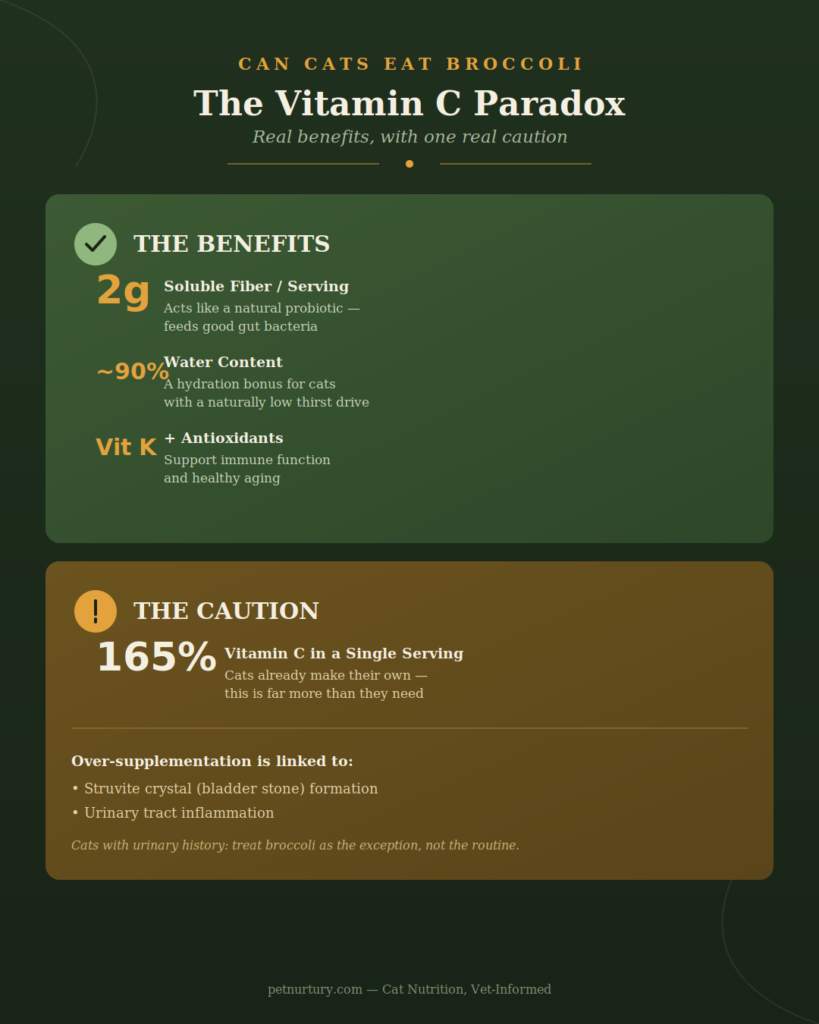
Here’s where broccoli gets more complicated than most owners expect. It’s genuinely rich in Vitamin C and Vitamin K, nutrients that support immune function and healthy aging. That sounds like an unambiguous win, but cats already produce their own Vitamin C internally, so they don’t need much from food, and broccoli delivers a lot of it. A single serving can provide well over 100% of what’s typically referenced for a cat’s needs.
Too much Vitamin C, delivered too often, has been linked to bladder stone formation, specifically struvite crystals, and urinary tract inflammation in cats prone to those issues. This isn’t a reason to avoid broccoli altogether, but it is a real reason to keep servings occasional rather than routine. If your cat has any history of urinary trouble or sensitive digestion, treat broccoli as an exception rather than a regular offering, and loop in your vet before adding it back in.
The 3-Minute Preparation Protocol
Raw broccoli is off the table, literally. It’s tough, fibrous, and a genuine choking hazard, and a cat’s digestive system isn’t built to break it down efficiently in that state. The fix is simple:
Florets only. Discard the thick stems; they’re the hardest part to digest and the least appealing part for most cats anyway.
Steam or boil in plain water for 3 to 4 minutes. That’s enough to soften the floret without cooking it into mush. Overdo it, and broccoli develops a stronger sulfur smell that’s often enough to make a cat turn up their nose at the whole thing.
Nothing added, ever. No butter, no salt, no oil, and absolutely no garlic or onion. Allium vegetables are highly toxic to cats regardless of quantity, and a lot of home cooks season broccoli with them out of habit. Keep your cat’s portion separate and plain before it ever touches your seasoned batch.
Serving Standards: The 10% Rule
Broccoli, like any treat, should stay under 10% of a cat’s total daily calories. For a healthy adult cat, that generally works out to one or two thumb-sized pieces, cut smaller for easier eating, offered once or twice a week at most. This isn’t a food you build into a daily routine.
Kittens are a separate case entirely. Their calorie and nutrient needs are almost entirely dedicated to growth, so it’s best to hold off on broccoli, or any vegetable treat, until they’re at least a year old.
Identifying Red Flags: When to Call the Vet
Watch for gas, vomiting, diarrhea, or a drop in appetite after a first try, mild digestive noise is common when introducing anything new, but it should settle within a day. If it doesn’t resolve within 24 hours, that’s your cue to call.
Some situations need faster action. Gagging or visible choking after eating broccoli is an emergency, and so is any broccoli that was seasoned with garlic or onion before your cat got to it, even a small amount of allium exposure is worth an immediate call to your vet or the ASPCA Animal Poison Control Center.
How Broccoli Stacks Up: Fiber Comparison
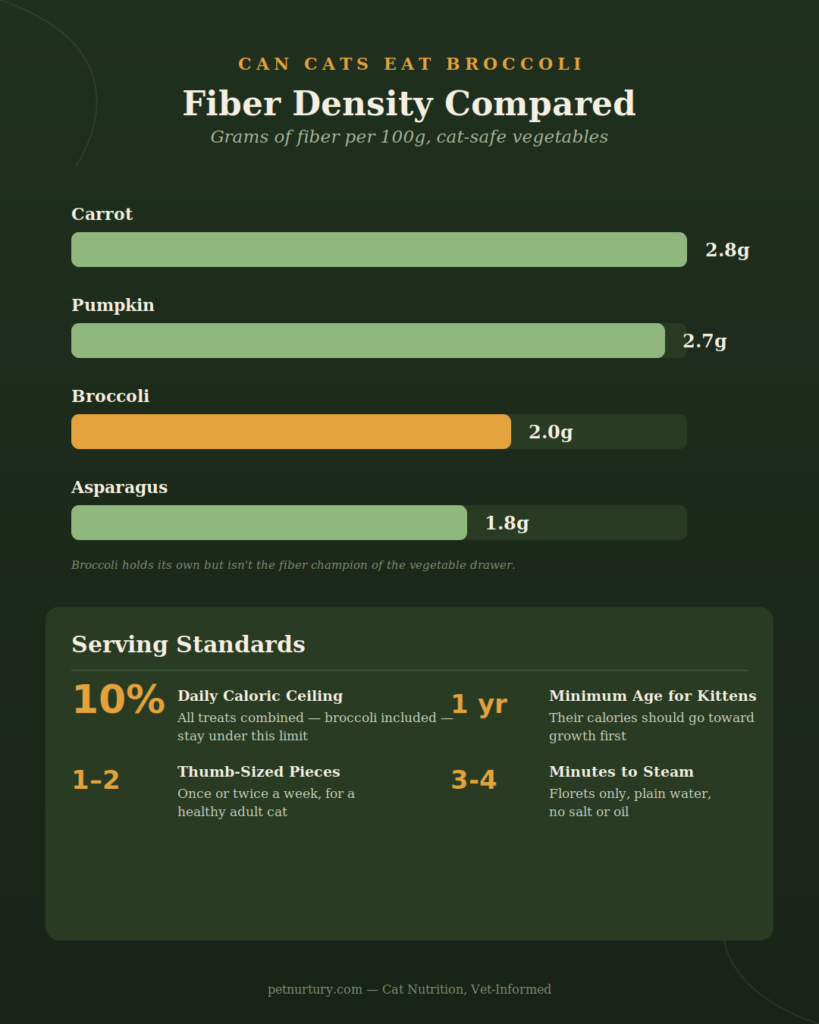
For context, here’s how broccoli’s fiber content compares to other vegetables commonly asked about alongside what vegetables cats can eat, per 100 grams:
| Vegetable | Fiber (per 100g) |
|---|---|
| Carrot | 2.8 g |
| Pumpkin | 2.7 g |
| Broccoli | 2.0 g |
| Asparagus | 1.8 g |
Broccoli holds its own, though it’s not the fiber champion of the vegetable drawer. Vegetables like carrots edge it out slightly, while starchier options like potatoes bring an entirely different risk profile, raw potato in particular carries solanine, a toxin cats should never be exposed to, which is worth knowing if broccoli has you wondering what else is safe to experiment with.
The Bottom Line
Can cats eat broccoli? In small, plain, well-cooked amounts, yes, and it can offer a modest fiber and hydration boost along the way. Just keep it occasional, keep it plain, and watch for how your own cat’s body responds, especially if there’s any history of urinary or digestive sensitivity. Like most human vegetables, it’s a supplement to curiosity, not a staple of the diet.
If you’re exploring alternatives, such as whether can cats eat potatoes, it’s important to evaluate each vegetable on its own, as safety guidelines can differ significantly between them.