Can Cats Eat Garlic? TOXIC WARNING: Why Garlic Poisons Cats
If you cook with garlic every day, it’s easy to assume it’s just a healthy kitchen staple, after all, we humans treat it almost like a natural antibiotic. So it catches a lot of owners off guard to learn the direct answer to “can cats eat garlic?” is a firm no. What’s healthy for you can be genuinely dangerous for your cat, and garlic toxicity in cats is one of the more serious food risks out there.
Here’s the number that tends to surprise people most: garlic is roughly five times more toxic to cats than onions, gram for gram. And because garlic powder and spice blends are far more concentrated than a fresh clove, even a light sprinkle of seasoning on your dinner can carry more risk than you’d expect. This isn’t a “too much of a good thing” situation, it’s toxic at any real amount.
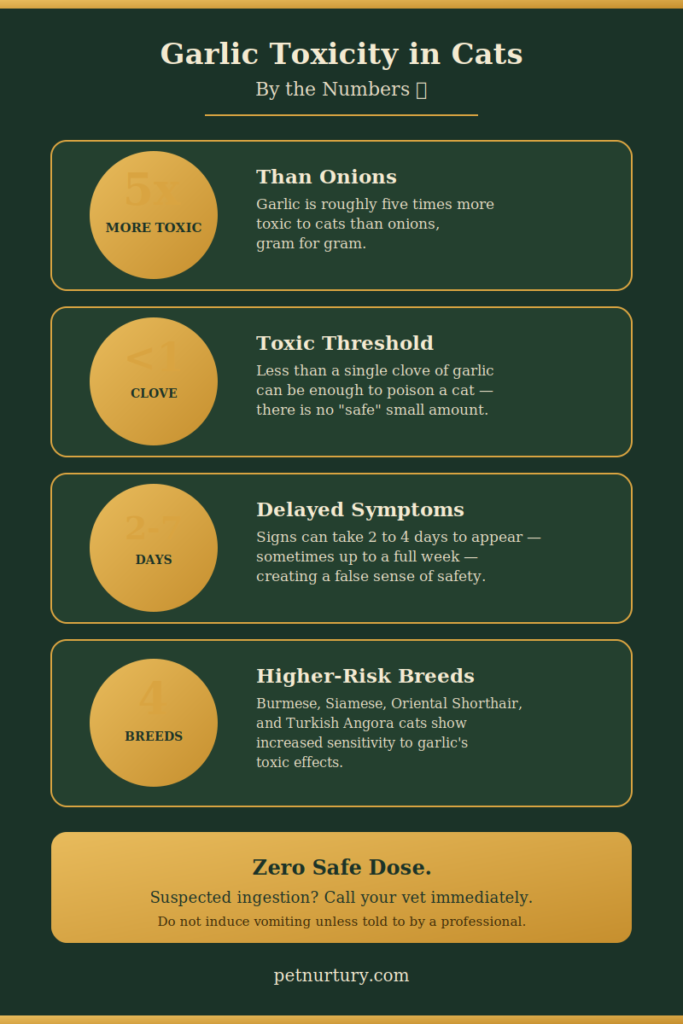
Table of Contents
Why Garlic Poisons Cats: The Biology Behind It
Garlic belongs to the Allium family, the same plant group as onions, leeks, chives, and shallots, which is why you’ll often see all of them grouped together as off-limits for cats. These plants contain organic sulfur compounds that cause oxidative damage to red blood cells.
That damage sets off a condition called hemolytic anemia, where the body destroys red blood cells faster than it can replace them. Since red blood cells carry oxygen throughout the body, a cat with hemolytic anemia is essentially running low on its own internal oxygen supply, which is why the symptoms can escalate quickly once they start.
How Much Garlic Is Too Much?
This is where garlic really stands apart from a lot of other “toxic to cats” foods: less than a single clove can be enough to cause poisoning. There’s no safe “small amount” to rely on.
That said, the severity of a reaction depends on a few variables, the cat’s body weight, overall health history, and even breed. Some breeds are known to be more sensitive to garlic’s effects than others, including Burmese, Siamese, Oriental Shorthair, and Turkish Angora cats. If you share your home with one of these breeds, it’s worth being extra vigilant about keeping garlic and garlic-seasoned food completely out of reach.
The Delayed Symptom Timeline
One of the trickiest parts of garlic toxicity is that it doesn’t announce itself right away. Symptoms often don’t show up for 2 to 4 days, and in some cases can take up to a full week to appear, which means a cat can seem perfectly fine for days after eating something they shouldn’t have.
Early on, you might notice nausea, drooling, vomiting, diarrhea, or stomach pain, signs that are easy to mistake for a routine stomach bug. As toxicity advances, watch for pale gums, lethargy, weakness, and jaundice, along with an increased heart rate, faster breathing, and panting. One of the clearest internal red flags is red or brown discolored urine, which signals that red blood cells are breaking down.
What To Do If Your Cat Eats Garlic
If you suspect your cat has eaten garlic in any form, call a vet immediately and keep a close eye on them for any signs of distress. Encouraging your cat to drink water can help support their system, but you should only induce vomiting if a veterinary professional specifically tells you to, doing it the wrong way can cause more harm than good.
At the clinic, treatment depends on how recently the exposure happened. Vets may use a hydrogen peroxide solution to induce vomiting or perform gastric lavage (essentially pumping the stomach) if it’s caught early enough.
Activated charcoal is often given to stop remaining toxins from being absorbed into the bloodstream. For cats already showing symptoms, supportive care can include IV fluids for dehydration, oxygen therapy, and, in more severe cases, a blood transfusion to replace lost red blood cells.
Cutting Through the Misinformation
It’s worth addressing something you may have come across online: a handful of older natural-health guides once suggested small doses of garlic as a home remedy for parasites. Modern veterinary medicine generally advises strongly against this, given how well-documented the toxicity risk is.
You may have also noticed a rise in “natural” pet products that include garlic as an ingredient, marketed for things like flea prevention. Veterinarians have flagged a matching uptick in garlic-related poisoning cases tied to these products, which is why pet welfare organizations have leaned into social media to warn owners about garlic hiding in home-cooked meals and well-intentioned natural remedies alike. If a product for your cat lists garlic on the label, it’s worth a second look, and probably a pass.
Prevention and Safer Alternatives
The simplest way to protect your cat is to keep garlic-containing products, cloves, powder, seasoning blends, pre-made sauces, stored somewhere they can’t investigate, and to never feed them meat or scraps that were cooked with garlic, onions, or other seasonings.
This is really an extension of the same caution owners already apply when figuring out what can cats eat safely day to day: when in doubt about an ingredient, leave it out. If you’re looking for cat-safe herbs to add a little variety, catnip, parsley, and basil are good options that don’t carry the same risk.
And if you’re building out a broader list of what vegetables can cats eat, it’s worth remembering that the entire onion-and-garlic family is the one hard exception, the same caution applies whether you’re wondering can cats eat onions or handling garlic in the kitchen.
The Bottom Line
Garlic’s reputation as a “healthy” ingredient doesn’t carry over to cats, if anything, it’s one of the more potent everyday toxins in a typical kitchen.
Keep it locked away, watch for delayed symptoms after any accidental exposure, and don’t hesitate to call your vet the moment you suspect ingestion. Fast action is still the biggest factor in a good outcome.