Can Cats Eat Mushrooms? Safe Types, Risks & Emergency
It’s a strange thing to watch, a cat, an obligate carnivore through and through, showing genuine interest in a mushroom on the cutting board.
The explanation is simpler than it looks: mushrooms are rich in glutamate, the compound behind umami, that deep “meaty” flavor cats are biologically drawn to.
Their interest isn’t random; it’s their nose picking up something that smells adjacent to protein, even though a mushroom is about as far from meat as a food gets. So can cats eat mushrooms? The honest answer splits sharply in two directions.
Plain, store-bought mushrooms, cooked properly, are generally safe in small amounts. Wild mushrooms are an entirely different category, genuinely dangerous, sometimes fatally so. Knowing which side of that line you’re on matters more with mushrooms than with almost any other food on this list.
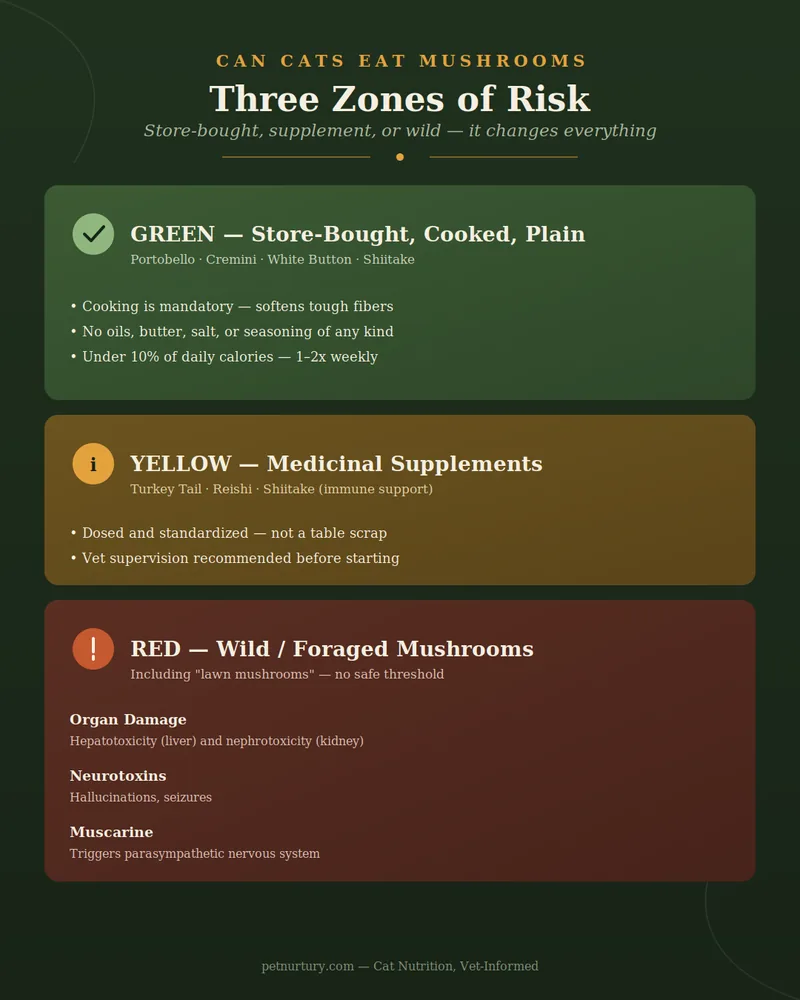
Table of Contents
The Green Light Zone: Safe Store-Bought Options
Portobello, cremini, white button, and shiitake mushrooms are the varieties generally considered safe for cats when prepared correctly. That preparation isn’t optional, it’s the difference between a fine treat and a digestive problem.
Cooking is mandatory. Raw mushrooms have tough fibers that a cat’s digestive system struggles to break down. Cooking softens them enough to actually be digestible.
Keep it plain. No oils, butter, salt, garlic, or any seasoning. This is the same rule that governs practically every vegetable a cat eats, and mushrooms are no exception, arguably more important here, since some of the seasonings people typically cook mushrooms with are the actual danger, not the fungus itself.
Mind the portion. Mushrooms fit into the standard 10% treat rule, no more than 10% of daily caloric intake from treats overall, and realistically, a small piece once or twice a week is plenty.
The Yellow Light Zone: Medicinal and Commercial Use
You won’t find mushrooms as a primary ingredient in most commercial cat food, and that’s not an oversight, they simply don’t offer enough nutritional density to justify a starring role in a carnivore’s diet.
Where mushrooms do show up more seriously is in functional supplements. Medicinal varieties like turkey tail, reishi, and shiitake appear in immune-support products formulated specifically for cats, often used alongside conventional treatment for certain conditions.
This is a fundamentally different category from a table-scrap mushroom, though, these supplements are dosed, standardized, and generally introduced under veterinary guidance rather than handed over casually. If you’re curious about medicinal mushroom supplements for your cat, that’s a conversation for your vet, not a DIY project.
The Red Light Zone: Where It Gets Genuinely Dangerous
This is the section that matters most. Wild mushrooms, including the ones growing in your own lawn, are strictly off-limits, full stop. Unlike a lot of “avoid in large amounts” food warnings, this one has no safe threshold, because identifying a wild mushroom accurately requires expertise most owners (and plenty of professionals) don’t have.
The toxin profile varies by species, but the outcomes are consistently serious:
Organ damage. Amanita species can cause hepatotoxicity, liver damage, along with kidney damage (nephrotoxicity) in other varieties. This kind of damage often isn’t immediately obvious, which makes it more dangerous, not less.
Neurotoxic effects. Some species cause hallucinations or seizures. “Magic” mushrooms specifically carry compounds that are genuinely dangerous for cats, not just a source of odd behavior.
Muscarine. Found in certain species, this compound triggers the parasympathetic nervous system, leading to symptoms like drooling, vomiting, and slowed heart rate.
There’s a second, easy-to-miss danger even with genuinely safe mushrooms: what they’re cooked with. Garlic, onion, and leeks are all highly toxic to cats, and they’re common enough in mushroom dishes that a “safe” mushroom prepared for human cooking is often anything but safe for a cat by the time it reaches the pan.
A Reality Check on Nutrition
It’s worth being honest about what mushrooms actually offer here: some fiber, some B vitamins, some water content. None of it amounts to much in the quantities a cat could realistically and safely eat.
This isn’t a superfood conversation, cats are obligate carnivores, and meat has to remain the foundation of their diet regardless of how many mushrooms make the safe list.
If you’re exploring what vegetables cats can eat more broadly, mushrooms are worth knowing about mainly for what to avoid, not for what they add nutritionally.
Emergency Action Plan
If your cat gets into a mushroom you can’t positively identify as a safe store-bought variety, timing and information matter.
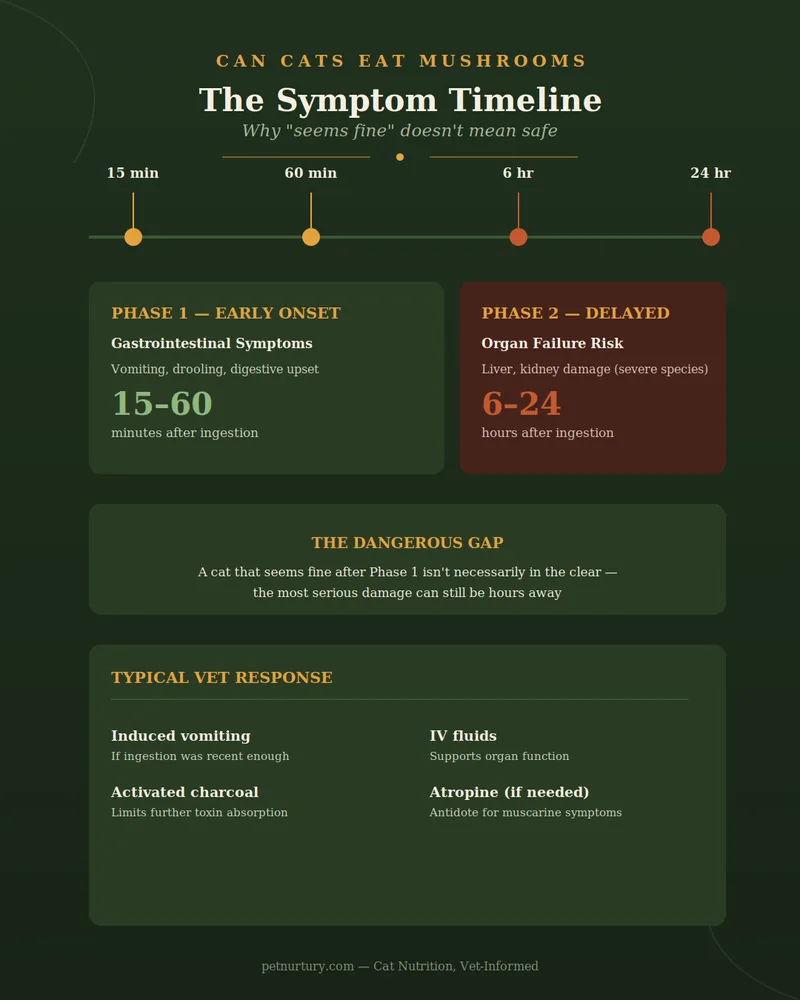
Watch the timeline. Gastrointestinal symptoms can appear within 15 to 60 minutes. Organ failure from more toxic species can be delayed 6 to 24 hours, which means a cat that seems fine an hour after eating something isn’t necessarily in the clear.
Take a photo or sample. If you can safely grab a piece of whatever your cat ate, do it, accurate identification makes a real difference in how a vet or poison control approaches treatment.
Call immediately. Contact your vet or an animal poison control hotline right away rather than waiting to see if symptoms develop.
What treatment typically looks like: depending on timing and severity, vets may induce vomiting, administer activated charcoal to limit absorption, provide IV fluids to support organ function, or use specific antidotes like atropine for muscarine-related symptoms.
Format and Age Notes Worth Knowing
| Format | Safe for Cats? | Notes |
|---|---|---|
| Fresh, cooked, plain | Yes | The standard safe preparation |
| Canned mushrooms | Caution | Often high in sodium — check the label |
| Dried mushrooms | Caution | Concentrated — rehydrate and cook plain before serving |
| Fried mushrooms | No | Oil and typical seasoning make these unsafe |
| Wild/foraged | No | Never — even for “lawn mushrooms” |
Kittens are a separate consideration entirely, it’s generally best to hold off on any experimental human food, mushrooms included, until they’re fully grown and established on a complete diet.
If you’re looking for a cat-safe way to include mushrooms in something more substantial, a small amount of plain cooked mushroom mixed into a homemade tuna-based treat (no seasoning, no onion or garlic) is about as far as this should go, and it’s worth mentioning that can cats eat zucchini is a similarly cautious yes, making it a reasonable rotation partner if you’re building out a small, safe list of vegetable add-ins.
The Bottom Line
Can cats eat mushrooms? Store-bought, cooked, and plain, yes, in small amounts. Wild, never, without exception.
The gap between those two answers is wide enough that it’s worth treating “mushroom” as two entirely different foods depending on where it came from.
When you’re weighing what can cats eat as an occasional extra, mushrooms can stay on the list, as long as you’re strict about the source.