
Can Cats Eat Spinach? Expert Guide to Safety, Kidney Stones & Risk
Spinach gets treated like a nutritional gold standard in human kitchens, Popeye wasn’t wrong about the iron. So it’s natural to wonder whether that same “superfood” status carries over to your cat. Can cats eat spinach? The honest answer is: sometimes, and it depends more on your specific cat’s health than almost any other vegetable on this list.
Cats are obligate carnivores, built to run on meat-based nutrients like taurine that no leafy green can supply. That alone means spinach was never going to be a health food for a cat the way it is for us.
But there’s a second, more important layer here, spinach isn’t just “not necessary,” it’s conditionally risky, which puts it in a different category from most vegetables. Think of it less as a food and more as an occasional garnish, and only for the right cat.
Table of Contents
The Oxalate Dilemma: When Greens Become Dangerous
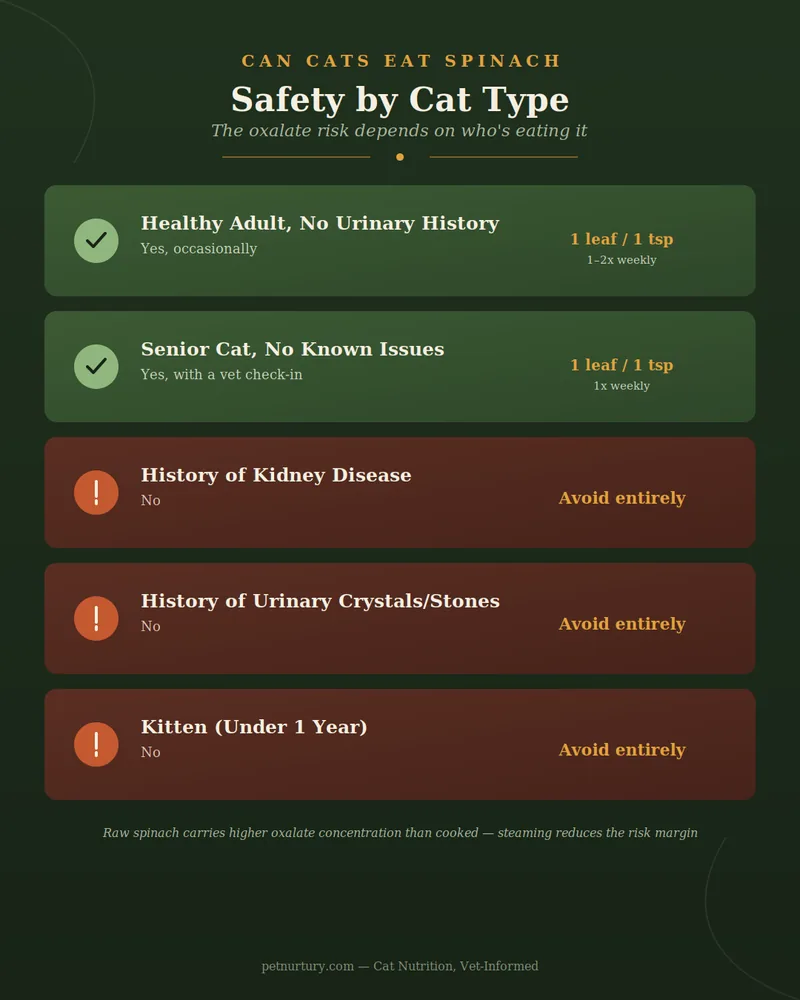
Here’s the chemistry that matters. Spinach is high in calcium oxalates, compounds that can bind together in a cat’s body and contribute to painful bladder or kidney stones. This isn’t a theoretical risk, it’s the single biggest reason spinach isn’t treated as casually as, say, cucumber or pumpkin.
Raw spinach carries a notably higher concentration of oxalates than cooked spinach, which is part of why preparation matters so much here. But concentration aside, there’s a category of cat for whom spinach should be avoided entirely, full stop: any cat with existing kidney disease or a history of urinary tract issues.
For these cats, even a small amount isn’t worth the risk, and it’s exactly the kind of pre-existing condition your vet should weigh in on before spinach goes anywhere near the bowl.
The Garnish Rule: How Much Is Actually Safe
For a healthy cat with no urinary or kidney history, the safe amount is small, one small leaf or about a teaspoon, offered once or twice a week at most. That’s not a starting point you gradually increase; it’s roughly the ceiling.
This fits into the broader 90/10 standard that governs most treat decisions: at least 90% of a cat’s daily calories should come from complete, balanced cat food, with everything else, spinach included, sharing the remaining 10%.
Kittens under a year old should skip leafy greens altogether; their growth depends on nutrients that specialized kitten food is formulated to deliver precisely, and there’s no upside to introducing spinach into that equation early.
Preparing It Safely: Plain Only
Steam it. Steaming softens the leaves for easier digestion and can help reduce oxalate concentration compared to serving it raw, a small but meaningful safety margin.
Skip every human addition. Garlic, onions, butter, salt, and cream are common in how people cook spinach, and every one of them is a problem for cats, some toxic outright, others just a fast track to an upset stomach. Your cat’s portion needs to be set aside and cooked separately, plain, before any seasoning touches the pan.
Watch the garden. If your cat has access to spinach growing outdoors, make sure there’s no pesticide residue or garden treatment on the leaves before they get anywhere near a curious cat.
Warning Signs Every Owner Should Know
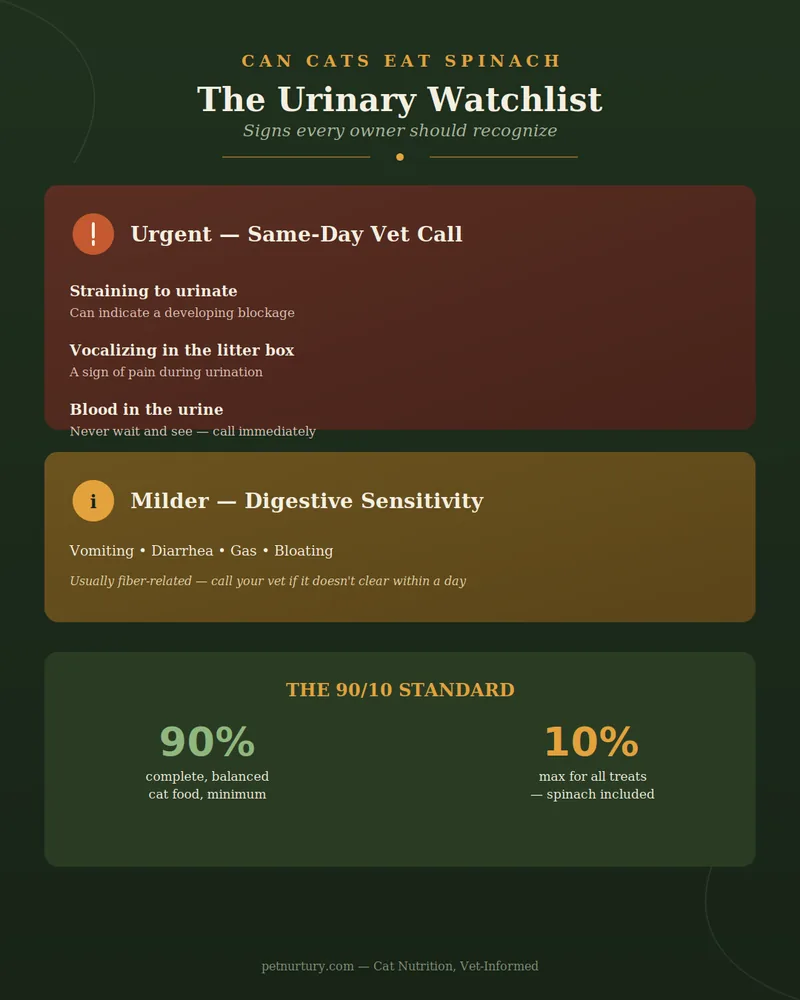
Because the real risk with spinach is urinary, not just digestive, it’s worth knowing exactly what to watch for. Straining to urinate, vocalizing in the litter box, or any visible blood in the urine are urgent signs that need a same-day vet call, these can indicate a developing blockage, which is a genuine emergency in cats.
On the milder end, watch for vomiting, diarrhea, gas, or bloating, which usually point to simple fiber sensitivity rather than anything urinary. If digestive symptoms don’t clear up within a day, or if you see any of the urinary red flags at all, contact your vet or the Pet Poison Helpline right away.
Why Spinach Shows Up in Commercial Cat Food Anyway
If spinach carries real risk, it’s fair to wonder why it appears as an ingredient in reputable cat food at all. The answer is control: brands like Wellness CORE, Blue Buffalo, and Hill’s Science Diet include spinach in precisely measured amounts, formulated specifically to deliver antioxidants and fiber without approaching anything close to a risky oxalate load.
That’s a very different scenario from a cat free-feeding on raw leaves off your cutting board, the ingredient is the same, but the control is what makes the difference.
Quick-Reference: Spinach Safety by Cat Type
| Cat Profile | Safe to Offer Spinach? | Recommended Amount |
|---|---|---|
| Healthy adult, no urinary history | Yes, occasionally | 1 leaf or 1 tsp, 1–2x/week |
| History of kidney disease | No | Avoid entirely |
| History of urinary crystals/stones | No | Avoid entirely |
| Kitten (under 1 year) | No | Avoid entirely |
| Senior cat, no known issues | Yes, with vet check-in | 1 leaf or 1 tsp, 1x/week |
A Note on Curiosity and Alternatives
Some cats are drawn to spinach purely for the texture or smell of the leaves, it’s a curiosity thing more than a nutritional drive, and that’s normal, harmless behavior in cats who don’t fall into any of the risk categories above.
If you’re looking to round out what vegetables can cats eat with lower-risk options, plain cooked shrimp, steamed carrots, and green beans are all safer everyday alternatives, and if your cat seems drawn to crunchy greens specifically, it’s worth knowing that can cats eat celery is another cautious yes, with a similar “small amount, plain, occasional” rule attached.
The Bottom Line
Spinach sits in an unusual spot among what can cats eat safely, genuinely nutritious in theory, genuinely risky in specific circumstances.
For a healthy cat with no urinary or kidney history, a small, occasional, plain-cooked amount is fine. For any cat with a relevant medical history, it’s simply not worth it.
When in doubt, your vet can tell you in five minutes which category your cat falls into, which is five minutes well spent before spinach becomes part of the routine.