Can Cats Eat Chocolate? Why It’s Toxic and What to Do
It’s a familiar scene: you’re unwrapping a chocolate bar, and your cat suddenly appears, sniffing curiously at the wrapper. Maybe they’ve even lapped up a little leftover hot cocoa from your mug before you noticed. It raises an immediate question, can cats eat chocolate, even in tiny amounts?
The answer is unequivocal: no. Chocolate is strictly toxic to cats, and depending on the type and quantity, it can be fatal. While chocolate poisoning is reported less frequently in cats than in dogs, cats are pickier eaters and lack a strong sweet tooth, some genuinely develop a taste for milk-based chocolate drinks, which makes this a real risk worth understanding, not a theoretical one.
The core problem is biological. Cats simply cannot process certain compounds in cocoa the way humans can, and that inability leads to a dangerous buildup in their system. Here’s exactly what happens, why it matters, and what to do if it happens to your cat.
Table of Contents
The Science of Poisoning: Theobromine and Caffeine
Chocolate contains a class of compounds called methylxanthines, specifically theobromine and caffeine. In humans, our livers metabolize these stimulants efficiently, which is why a cup of coffee or a chocolate bar produces a mild, temporary effect and then clears from our system.
Cats are built differently. Their metabolism processes methylxanthines extremely slowly, which means theobromine and caffeine accumulate in their bloodstream rather than being cleared at a safe rate. This buildup primarily targets the central nervous system and the heart, and in severe cases, the toxic load can be significant enough to cause liver failure. This is the central reason why asking what foods cats can eat always returns the same answer for chocolate: none, ever, in any form.
The Toxicity Spectrum: What Actually Matters
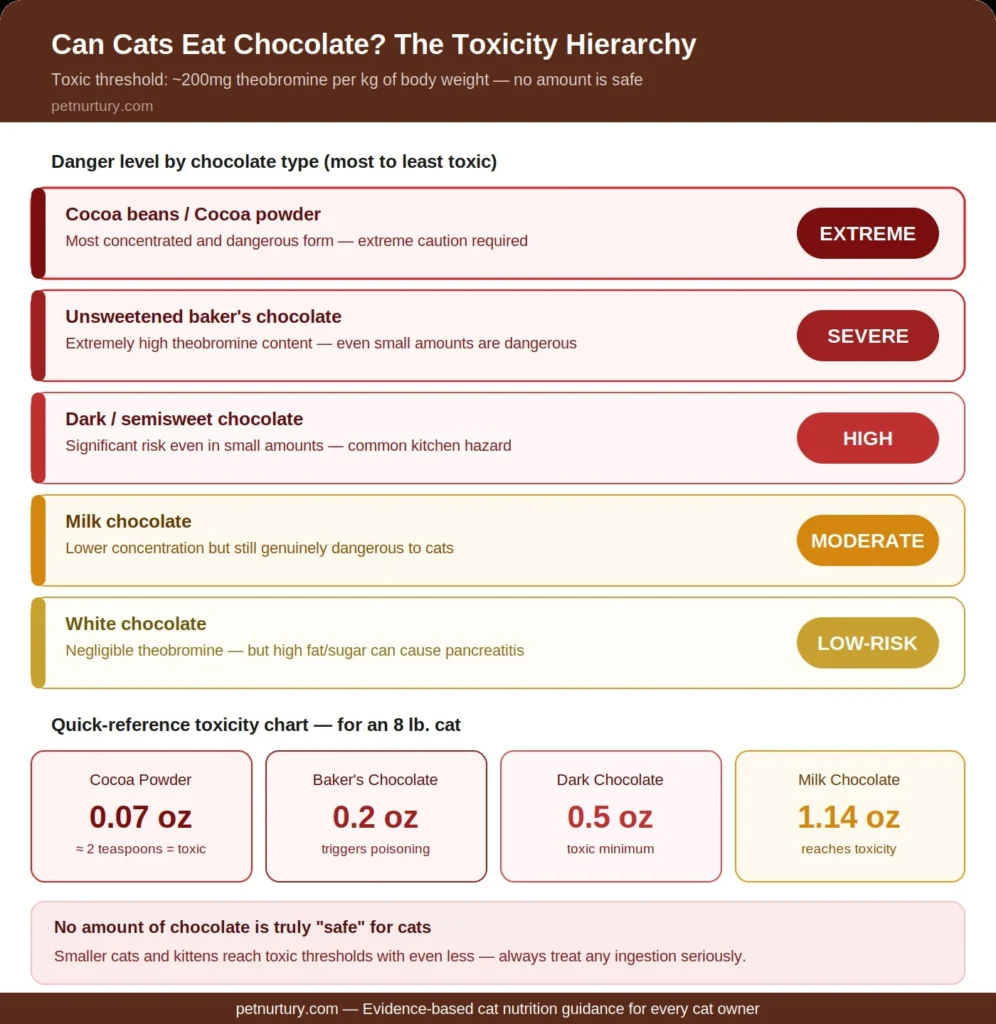
Not all chocolate carries equal risk, and understanding the hierarchy can help you gauge the urgency of any exposure.
The toxic threshold for theobromine in cats sits at approximately 200 milligrams per kilogram of body weight, though smaller amounts can still cause illness, and this threshold should never be treated as a “safe” cutoff.
The hierarchy of danger, from most to least toxic, follows the concentration of cocoa solids:
- Cocoa beans and cocoa powder, the most concentrated and dangerous form
- Unsweetened baker’s chocolate, extremely high theobromine content
- Dark or semisweet chocolate, significant risk even in small amounts
- Milk chocolate, lower concentration, but still genuinely dangerous
- White chocolate, contains negligible theobromine, but the high fat and sugar content can still cause illness, including pancreatitis
Quick-Reference Toxicity Chart (8 lb. Cat)
To put this in concrete terms, here’s how little it takes to reach toxic levels for an average 8-pound cat:
- Cocoa powder: Just 0.07 oz (roughly two teaspoons) can be toxic
- Baker’s chocolate: 0.2 oz can trigger poisoning
- Dark/semisweet chocolate: 0.5 oz is the toxic minimum
- Milk chocolate: 1.14 oz reaches toxicity levels
These numbers are sobering precisely because they’re so small. A single square of baker’s chocolate or a couple of dark chocolate chips can be enough to cause real harm to a cat that size.
Symptom Timeline and Recognition
Chocolate poisoning doesn’t always announce itself immediately, which is part of what makes it dangerous. Symptoms typically appear within 6 to 12 hours of ingestion and can persist for as long as 3 days, depending on the amount consumed and how quickly treatment begins.
Mild to moderate signs to watch for include:
- Restlessness and unusual hyperactivity
- Vomiting and diarrhea
- Increased thirst and more frequent urination
Severe, life-threatening signs include:
- Muscle tremors or full seizures
- Rapid, irregular heartbeat (arrhythmia) and heavy panting
- Loss of consciousness or coma
If you notice any of the severe symptoms, this is a true emergency, not a “watch and wait” situation.
Emergency Response Protocol
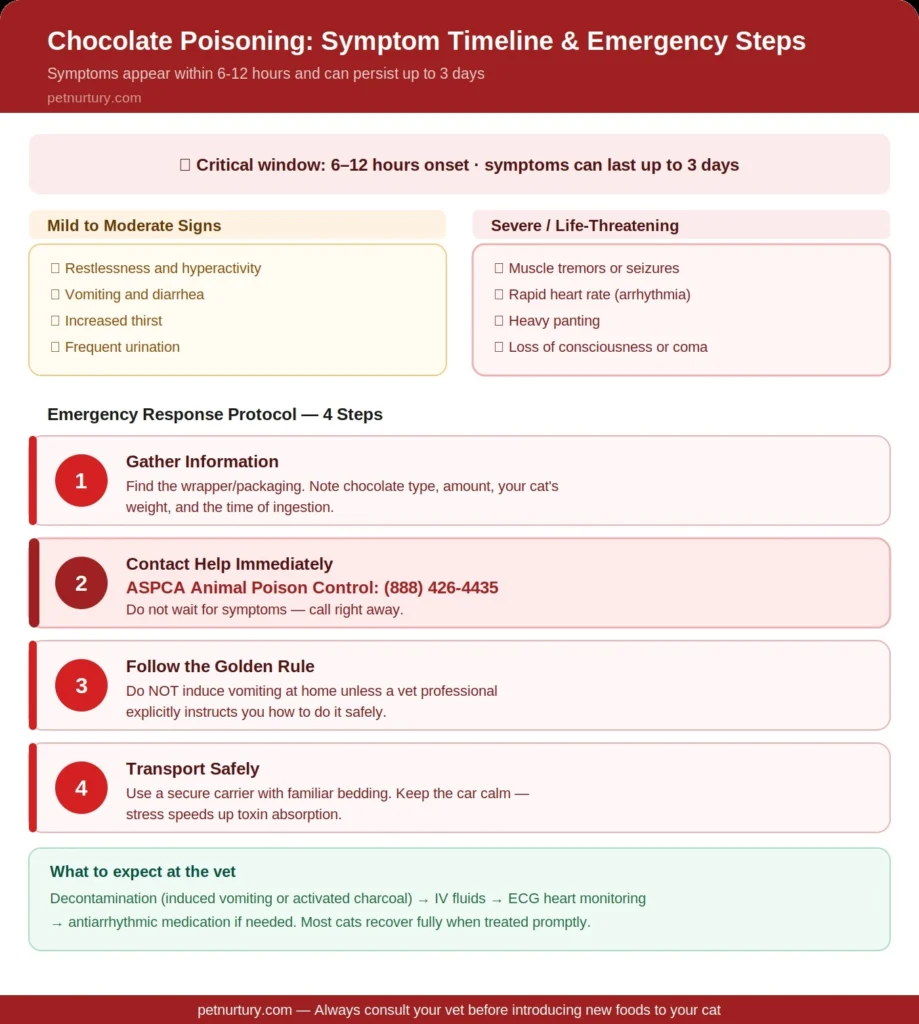
If you know or suspect your cat has eaten chocolate, here’s exactly what to do, in order.
Step 1, Gather information. Find the chocolate wrapper or packaging to identify exactly what type was consumed and roughly how much. Note your cat’s weight and the approximate time of ingestion. This information will be critical for whoever you call next.
Step 2, Contact help immediately. Call your veterinarian or the ASPCA Animal Poison Control Center (APCC) at (888) 426-4435 right away. Don’t wait to see if symptoms develop — early intervention significantly improves outcomes.
Step 3, Follow the golden rule. Do not attempt to induce vomiting at home unless a veterinary professional explicitly instructs you to do so and tells you how. Doing this incorrectly can cause additional harm.
Step 4, Transport safely. If you’re heading to the vet, keep your cat in a secure carrier with familiar bedding, and keep the car as quiet and calm as possible. Stress and excessive movement can increase heart rate, which speeds up toxin absorption, the opposite of what you want during an emergency.
What to Expect at the Vet
Once you arrive, treatment generally follows a predictable path depending on severity. Decontamination is often the first step, your vet may induce vomiting in a controlled clinical setting or administer activated charcoal, which binds to remaining toxins in the digestive tract and limits further absorption.
For more severe cases, supportive treatment can include IV fluids to support circulation and kidney function, continuous ECG heart monitoring to catch dangerous arrhythmias early, and antiarrhythmic medication if needed. Throughout recovery, the veterinary team will monitor blood pressure and body temperature closely, since both can fluctuate significantly during methylxanthine toxicity.
The good news: when caught early and treated promptly, most cats recover fully.
Prevention and Healthy Alternatives
The most effective protection is simple: keep chocolate completely out of reach. Store all chocolate, cocoa powder, and chocolate-flavored snacks, including cookies, donuts, and baking ingredients, in sealed containers inside high cabinets or behind closed pantry doors. Cats are agile and curious, so “out of sight” alone often isn’t enough; sealed and inaccessible is the real standard.
It’s also worth making sure every household member, including children, understands that chocolate is an absolute no-go for cats, even a “tiny taste” as a treat.
If you’re looking for safe ways to give your cat a special treat instead, there are genuinely good options. Diced cooked chicken or turkey (unsalted, skin removed) is a favorite for most cats and a safe go-to when you’re wondering what human food cats can eat everyday in small amounts. A little tuna, offered occasionally, also works well. Berries, banana slices, or cooked carrots make safe fruit and vegetable options in moderation. And for something a bit more novel, catnip tea or low-sodium broth frozen into ice cubes makes an engaging, hydrating treat that satisfies the instinct to investigate something new, without any of the risk.
Frequently Asked Questions
Is white chocolate safe for cats since it has less theobromine? No. While white chocolate contains only negligible theobromine, its high fat and sugar content can still cause vomiting, diarrhea, and in some cases pancreatitis. It should be avoided just like other chocolate types.
My cat licked a small amount of chocolate frosting. Should I worry? A tiny lick of milk chocolate,based frosting is less concerning than concentrated baking chocolate, but it’s still worth contacting your vet or poison control to confirm based on your cat’s weight and the amount involved. When in doubt, always call.
Can kittens tolerate chocolate better or worse than adult cats? Worse. Kittens have lower body weight and less metabolic reserve, meaning even small amounts of chocolate reach toxic thresholds far more easily than in adult cats. Extra caution is essential.
What’s a good cat food substitute if I run out of treats and want something safe? Plain cooked chicken or turkey, offered in small diced pieces, works well as a safe substitute for commercial treats in a pinch, just make sure it’s unsalted and unseasoned.