Can Cats Eat Onions? TOXIC WARNING: Why Onions Kill Cats
If you’ve ever dropped a piece of onion on the kitchen floor and watched your cat sniff around it, you’ve probably wondered: can cats eat onions, even just a little bit? The honest answer is no, not a little bit, not a lot, not ever. Onions are one of the few “everyday” foods that can turn a normal afternoon into an emergency vet visit, and most cat owners have no idea how serious the risk really is.
This isn’t a case of onions being “not great” for cats the way, say, too much dairy is not great. Onion toxicity in cats works at a cellular level, quietly damaging red blood cells long before you notice anything wrong. And here’s the part that catches people off guard: there’s no safe dose. A single bite of a cooked onion ring, a lick of gravy, or a spoonful of seasoned broth can be enough to make a cat seriously ill.
The reason awareness matters so much is that onion poisoning is almost always accidental. Nobody sets out to feed their cat onions. It happens through hidden ingredients, a taste of your dinner, a spoonful of baby food used to coax a sick cat into eating, or leftover pan drippings scraped into the food bowl. Understanding exactly why onions are dangerous is the best way to make sure it never happens in your house.
Table of Contents
Why Onions Are Toxic to Cats: The Biology Behind the Danger
Onions belong to the Allium family, and they contain compounds called n-propyl disulfide and various thiosulfates. In humans, these compounds are mostly harmless, they’re what make onions sting your eyes when you chop them. In cats, they’re a completely different story.
These compounds cause oxidative damage to red blood cells, essentially attacking the hemoglobin inside each cell. Damaged hemoglobin clumps together into structures called Heinz bodies, and the cat’s body starts destroying its own red blood cells to get rid of them. This process is called hemolytic anemia, and it means the cat is quite literally losing its ability to carry oxygen through its bloodstream.
So why are cats hit so much harder than dogs or humans? Two reasons. First, feline hemoglobin is structurally more fragile and more susceptible to this kind of oxidative stress.
Second, cats have a limited set of liver detoxification pathways, they lack certain enzymes that other animals use to break down and clear these compounds efficiently. Their livers simply aren’t built to process onion compounds the way ours are.
One detail that surprises a lot of owners: this toxicity is cumulative. It doesn’t reset. A cat who gets a small taste of onion gravy every few days isn’t in the clear just because each individual amount seems tiny, those repeated small exposures add up in the body over time, and the damage can eventually mirror what a single large dose would cause.
Fresh, Cooked, or Powdered — All Forms Are Dangerous
A lot of pet owners assume that cooking neutralizes toxins, the way heat kills certain bacteria. Unfortunately, that’s a myth when it comes to onions. Boiling, frying, roasting, or baking does nothing to break down n-propyl disulfide or thiosulfates. A cooked onion is just as dangerous as a raw one.
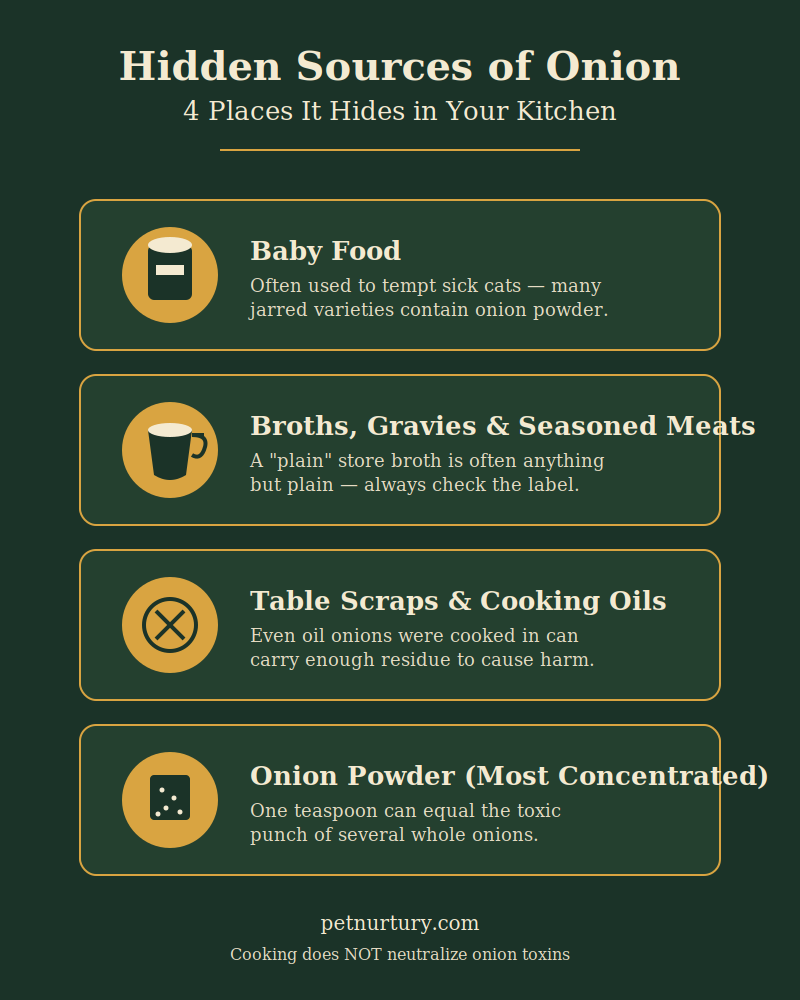
What’s more concerning is onion powder, which is far more concentrated than fresh onion. Gram for gram, a teaspoon of onion powder can pack the toxic punch of several whole onions, since the water content has been removed and the compounds are concentrated.
This makes powdered onion, the kind hiding in seasoning blends, stocks, and pre-made sauces, one of the sneakiest sources of poisoning.
When you’re auditing your kitchen for hidden onion risk, keep an eye on:
- Baby food, often mistakenly used to tempt a sick or picky cat into eating, but many jarred varieties contain onion powder.
- Broths, gravies, and seasoned meats, a “plain” broth from the store is frequently anything but plain.
- Table scraps and onion-infused cooking oils, even oil that onions were cooked in can carry enough residue to cause harm.
Reading labels and asking “does this have any onion or garlic in it, in any form?” before sharing food is the simplest habit that prevents most cases.
Warning Signs: Why the Delay Makes This So Dangerous
One of the trickiest aspects of onion poisoning is timing. The early signs are easy to write off, and the serious ones often don’t show up right away.
In the first few hours, you might notice vomiting, diarrhea, or drooling, symptoms that look like a dozen other minor stomach upsets. This is exactly what makes onion toxicity so dangerous: many owners see mild vomiting, assume it will pass, and move on with their day.
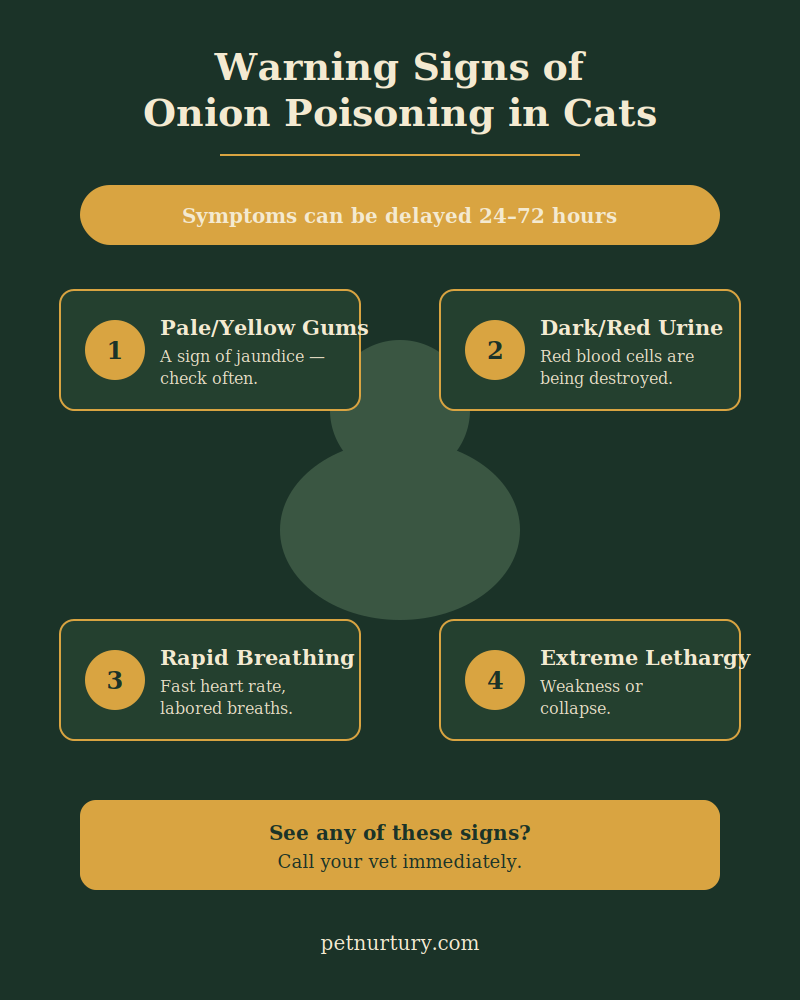
The real damage tends to unfold over the next 24 to 72 hours, as red blood cells continue breaking down. This delay creates a false sense of security; by the time more serious symptoms appear, the toxin has already been doing damage for a day or more. Watch for:
- Pale or yellowish gums (a sign of jaundice)
- Dark or reddish-brown urine, which points to red blood cells being destroyed
- Rapid breathing and a noticeably fast heart rate
- Extreme lethargy, weakness, or collapse
If your cat has eaten onion in any form and you notice any of these signs, even a day or two later, treat it as an emergency, not a “wait and see” situation.
What To Do If Your Cat Eats Onion
If you know or suspect your cat has eaten onion, call your vet or an animal poison control line immediately, even before symptoms show up. Decontamination is far more effective before the toxins are fully absorbed, so early action matters more than almost anything else.
One critical thing not to do: never try to induce vomiting at home. It’s a common instinct, but doing it incorrectly carries a real risk of aspiration, where vomit is inhaled into the lungs, a complication that can be more dangerous than the onion itself.
At the vet, treatment typically depends on how recently the onion was eaten and how the cat is doing. Options may include activated charcoal to reduce further absorption, IV fluids to support the kidneys and circulation, and in severe anemia cases, a blood transfusion to replace damaged red blood cells while the body recovers.
Prevention: Safer Snacks and a Cat-Proof Kitchen
The good news is that onion toxicity is almost entirely preventable. A few simple habits go a long way:
- Keep trash cans with food scraps secured, and make sure everyone in the household, including guests, knows not to feed table scraps without checking first.
- Store onions, garlic, and pre-made sauces somewhere your cat can’t investigate on the counter.
If you want to give your cat a taste of “people food” safely, there are good options. Plain, unseasoned cooked chicken or turkey (no onion, garlic, or heavy seasoning) is a favorite for most cats. If you’re wondering what vegetables can cats eat safely, steamed carrots or cucumber slices are gentle, low-risk choices that many cats enjoy in small amounts.
It’s also worth remembering that onions aren’t the only culprit. The entire Allium family is off-limits, and that includes garlic, which is actually considered roughly five times more potent than onion, along with leeks, chives, and shallots.
If you’ve ever asked yourself can cats eat garlic thinking it might be safer than onion, the answer is no, it deserves the same level of caution. When you’re figuring out what can cats eat day to day, treating the whole onion and garlic family as a hard no is the safest rule of thumb.
The Bottom Line
When it comes to onions, there’s really only one policy worth having: no onion, ever, in any form. Whether it’s fresh, cooked, powdered, or hidden in a jar of baby food, the risk to your cat’s red blood cells isn’t worth it.
If an accident does happen, the single biggest factor in a good outcome is how quickly you act, early intervention gives your cat the best possible chance at a full recovery. A little vigilance in the kitchen is a small price to pay for keeping your cat safe.