Can Cats Eat Zucchini? Benefits, Prep & Safety Guide
If your cat has ever shown up at the counter while you’re slicing zucchini for dinner, you’re not the only owner who’s wondered whether it’s safe to share. Can cats eat zucchini? Yes, it’s non-toxic, officially listed as safe by the ASPCA, and generally fine in moderation.
Cats are obligate carnivores, so nothing about zucchini changes their core nutritional needs, but it earns a real place among what vegetables cats can eat safely: a genuine exception that offers supplemental benefits without carrying the risk of something like onion or garlic.
Table of Contents
A Hydration and Vitamin Profile Worth Knowing
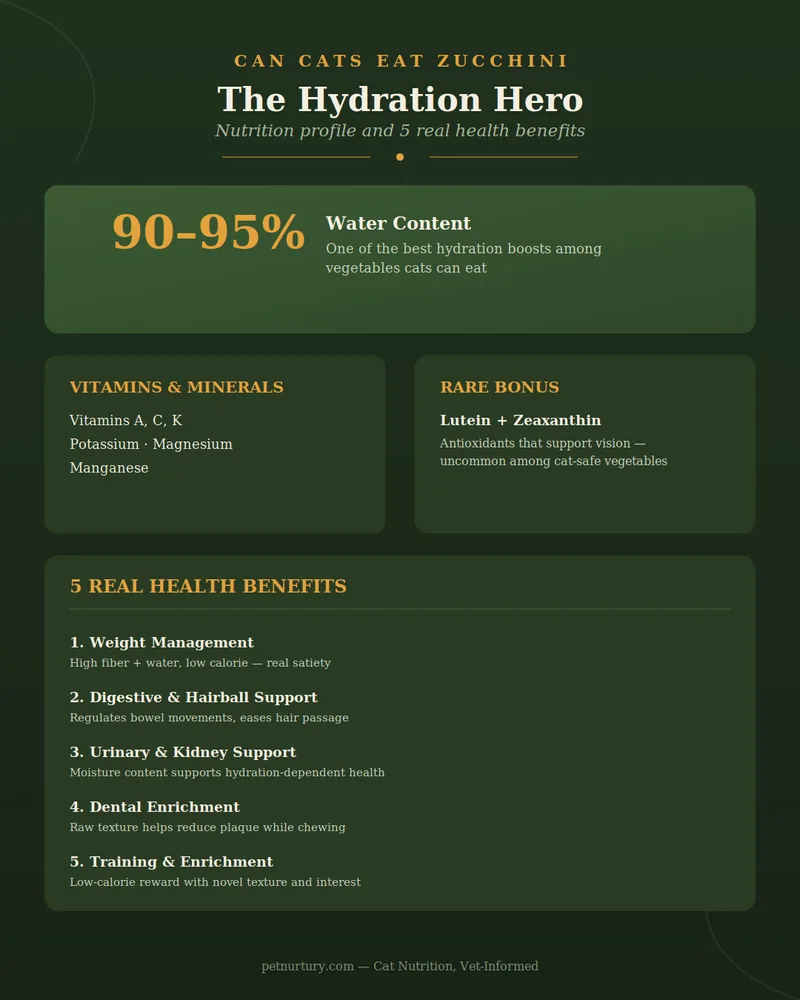
Zucchini is roughly 90–95% water, which makes it one of the more genuinely useful hydration boosts available for cats who don’t drink enough from the bowl on their own. Beyond water content, it brings vitamins A, C, and K to the table, along with potassium, magnesium, and manganese.
One detail that sets zucchini apart from a lot of other vegetables: it contains lutein and zeaxanthin, antioxidants specifically tied to eye health. These compounds support vision and may help slow age-related changes in a cat’s eyes, a benefit that’s genuinely uncommon among the vegetables typically discussed in conversations about what vegetables cats can eat.
Five Real Health Benefits
Weight management. High in fiber and water, low in calories, zucchini helps an overweight cat feel satisfied without the caloric cost of richer treats.
Digestive and hairball support. The mild fiber content helps regulate bowel movements, eases occasional constipation, and can help hair move through the digestive tract before it becomes a hairball problem.
Urinary and kidney support. The high moisture content contributes to overall hydration, which matters for kidney function and can be a meaningful supporting factor for cats with urinary tract concerns.
Dental enrichment. Raw zucchini’s crunchy texture can help reduce plaque and tartar buildup as a cat chews, while also offering a bit of mental stimulation through a new texture.
Training and enrichment. Low-calorie and novel enough to hold interest, zucchini works well as a training reward or simply as a new sensory experience in a cat’s day.
The Golden Rules of Preparation
Keep it plain, always. No seasoning, oils, butter, salt, onion, or garlic, all of which range from digestively harsh to outright toxic for cats.
Cooking helps, but isn’t mandatory. Raw zucchini is safe, but steaming, boiling, or baking softens it and makes it easier for a cat’s digestive system to process, especially for cats with sensitive stomachs.
Creative serving ideas worth trying:
- Zucchini ice cubes: freeze small pieces in water for a hydrating, engaging treat.
- Mash and mix: blend it into wet food for cats who won’t touch a vegetable on its own.
Prep basics. Wash thoroughly to remove pesticide residue, and peel the skin if it looks tough or waxy, most of the time it’s fine left on, but it’s worth checking.
Where the Real Risks Are
Cats lack the enzymes to break down large amounts of cellulose, the material that makes up plant cell walls, so overdoing zucchini can lead to vomiting or diarrhea even though the vegetable itself isn’t toxic.
The standard 10% treat rule applies here just like everywhere else: zucchini and any other treats combined shouldn’t exceed 10% of a cat’s daily caloric intake.
Cut pieces small to avoid choking, and treat one small zucchini’s worth per day as a reasonable ceiling for a healthy cat, overweight cats working on satiety might get slightly more under a vet’s guidance, but this isn’t a vegetable to feed freely.
Age, Variety, and Health-Specific Notes
| Consideration | Guidance |
|---|---|
| Kittens (under 4–8 weeks) | Not recommended — high-protein milk or solids only at this stage |
| Seeds | Generally safe, but large seeds can pose a choking risk |
| Flowers | Edible and safe as an occasional treat |
| Skin | Contains beneficial compounds like arginine — peel only if pesticide exposure is a concern |
| Diabetic cats | Generally safe due to low carbohydrate content |
| Kidney disease | Hydration benefit can be genuinely helpful, with vet guidance |
Why Some Cats Panic at the Sight of One
It’s worth mentioning the now-famous “scared of zucchini” phenomenon, since it’s closely related to the same reaction seen with cucumbers. A zucchini’s long, green shape can trigger a startled response in some cats, placed unexpectedly behind them, it can read as snake-like and set off an instinctive flinch. It’s a real, documented reaction rather than a personality quirk, and it’s not a reason to avoid zucchini as food, just a reason not to use one as a prank.
A Note on Rotating Vegetables Safely
If zucchini becomes a regular part of your cat’s treat rotation, it’s worth knowing what else belongs on that same safe list, and, just as importantly, what doesn’t. For contrast, can cats eat mushrooms is a much more conditional yes: store-bought and properly cooked mushrooms can be fine in small amounts, but wild varieties carry genuine toxicity risks that zucchini simply doesn’t. Knowing the difference matters if you’re building out a broader list of safe vegetable snacks rather than sticking to one.
The Bottom Line
Zucchini is a legitimately healthy, optional supplement, hydrating, low-calorie, and unusually good for eye health among vegetables.
It should complement high-quality animal protein, never replace it, which is really the standard for anything on the list of what can cats eat outside of a complete diet.
If your cat has a pre-existing health condition, loop in your veterinarian before making zucchini, or any new food, a regular part of the routine.