Prescription Cat Food for Kidney Disease Alternatives: Save $50-70/Month
It’s 2 AM, and Sarah is staring at her vet’s invoice: Hill’s k/d, $89 for a 8-lb bag. Her 12-year-old tabby, Milo, has just been diagnosed with Stage 3 chronic kidney disease.
“How long can he eat this?” she asks the vet.
“Until his condition stabilizes. Probably the rest of his life,” comes the answer.
Sarah does the math: $1,300 per year for kidney food alone. She loves Milo, but her budget can’t sustain $100+ monthly forever. This isn’t a rare scenario, it’s the reason cats with CKD go without therapeutic diets.
While prescription kidney diets are ideal, they’re not always realistic. Understanding what makes kidney nutrition work and how non-prescription alternatives can deliver similar results helps cat owners make informed decisions. For a broader look at condition-specific cat nutrition, explore our best cat food for every condition guide
Table of Contents
The Real Problem With Prescription Diets
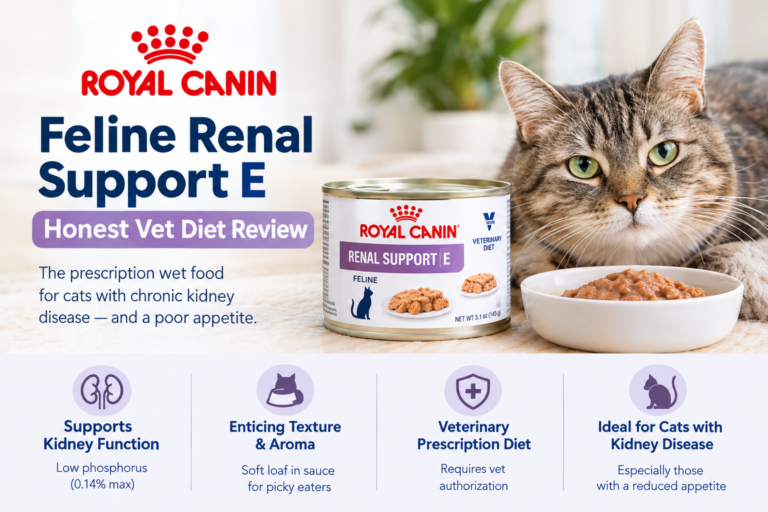
Prescription kidney formulas (Hill’s k/d, Royal Canin Renal, Purina NF) are medically superior because they’re engineered with precise phosphorus reduction (typically 0.4-0.5% vs. standard 0.6-0.8%). But they’re expensive: $60-90 per bag for wet food, $40-50 for dry.
What if you don’t have $1,300 yearly?
The answer isn’t to skip kidney diet entirely, it’s to understand what makes prescription diets work, then find non-prescription alternatives that deliver the same critical features at half (or less) the cost.
Quick Verdict: Non-Prescription Alternatives That Veterinarians Actually Recommend
| Product | Format | Price/Month | Phosphorus | Best For | Vet Approval |
|---|---|---|---|---|---|
| Weruva Wx (Kidney) | Wet | $22-28 | 0.28% | Low phosphorus champion | ⭐⭐⭐⭐ |
| Dave’s Pet Food | Wet/Dry | $18-25 | 0.32-0.38% | Budget-conscious owners | ⭐⭐⭐ |
| Blue Buffalo Wilderness | Dry | $16-20 | 0.38-0.42% | Early CKD (Stage 1-2) | ⭐⭐⭐ |
| Forza10 Diet Renal | Wet | $24-32 | 0.32% | Inflammation + kidney support | ⭐⭐⭐ |
| Fancy Feast Classic | Wet | $8-12 | 0.35-0.42% | Picky eaters + budget | ⭐⭐ |
| Hill’s k/d (Rx) | Wet/Dry | $60-90 | 0.35-0.43% | Gold standard, any stage | ⭐⭐⭐⭐⭐ |
| Royal Canin (Rx) | Wet/Dry | $55-85 | 0.38-0.45% | Sensitive digestive tracts | ⭐⭐⭐⭐ |
UNDERSTANDING KIDNEY DISEASE NUTRITION: Why Phosphorus Control Matters More Than Price
Before you choose an alternative, here’s the critical biology that vets won’t always explain:
For a complete therapeutic feeding guide covering all CKD stages and prescription options, our detailed best cat food for kidney disease resource explains the full scope of kidney-specific nutrition management.
The Phosphorus Trap: How Cats’ Kidneys Fail
In healthy cats, the kidneys filter excess phosphorus into urine. But CKD cats lose this ability progressively. Phosphorus accumulates in the blood, triggering:
- Hyperphosphatemia (elevated blood phosphorus) → triggers parathyroid hormone (PTH) release
- Secondary hyperparathyroidism → accelerates kidney tissue damage
- Vicious cycle → kidneys fail faster, more phosphorus accumulates
The data is clear: Multiple peer-reviewed studies show that reducing dietary phosphorus slows kidney disease progression. Cats on restricted phosphorus diets show:
- 40-60% slower creatinine increase (a marker of declining kidney function)
- Extended survival time (sometimes by 1-3 years)
- Reduced uremic symptoms (nausea, vomiting, appetite loss)
The point: You’re not paying for flavor or premium ingredients. You’re paying to extend your cat’s life by controlling one specific mineral.
The Obligate Carnivore Problem: Why “High Protein” Actually Matters
Here’s where non-prescription diets often fail: they’re formulated for healthy cats, which means adequate protein. CKD cats are obligate carnivores with different needs.
- Healthy cats: Need ~26-30% crude protein in dry food
- CKD cats: Need controlled protein (15-20%), but it MUST be high-quality, complete amino acids
Low-quality protein (like meat by-products) can worsen kidney disease because incomplete amino profiles mean more nitrogen waste to filter.
This is why Dave’s and Weruva work as alternatives, they use whole meat sources (chicken, turkey, fish) instead of by-products, even though protein is lower than standard foods.
THE COMPLETE COMPARISON: Prescription vs. Non-Prescription
🟢 SAFE for CKD Cats (Phosphorus <0.45%)
Prescription (Gold Standard)
Hill’s Science Diet k/d is the most researched kidney diet on the market. If your cat tolerates it and money is no object, this is the scientifically superior choice. Check Hill’s k/d on Amazon →
Why vets recommend it: Decades of clinical data, multiple renal formulations for different CKD stages, specifically engineered phosphorus/protein ratios.
Cost Reality: $60-90/month for adequate nutrition in a 12-lb cat.
Non-Prescription Champions (Veterinarian-Approved)
1. Weruva Wx Focus – Kidney Support
- Phosphorus: 0.28% (LOWEST on market)
- Protein: 8-10% crude
- Format: Wet (95% moisture = hydration benefit)
- Price: $22-28/month
- Why it works: Single-protein (chicken or turkey), easy digestibility, low phosphorus WITHOUT pharmaceutical approaches. Some cats refuse it initially due to aroma, warm to room temperature first.
Real-World Use: Marcus (11-year-old Persian) was thriving on Weruva Wx but only accepted it warmed in the microwave for 8 seconds. His phosphorus dropped from 5.8 mg/dL to 4.2 mg/dL over 4 months.
2. Dave’s Pet Food – High-Protein, Lower Phosphorus
- Phosphorus: 0.32-0.38% (depending on flavor)
- Protein: 9-11% (higher quality than budget brands)
- Format: Wet & Dry options
- Price: $18-25/month (dry is cheaper)
- Why it works: Whole meat first ingredient, no fillers, formulated for “sensitive systems”, includes gut bacteria balance that helps CKD cats maintain appetite.
Check Dave’s Kidney Diet on Amazon →
The Hydration Factor: Dave’s wet food is 78% moisture vs. dry at 10%. Kidney disease cats need fluid to flush uremic toxins, wet food acts as preventative therapy for urinary concentration issues.
3. Blue Buffalo Wilderness (Grain-Free) – Early CKD Option
- Phosphorus: 0.38-0.42%
- Protein: 30-38% (HIGHER than other alternatives)
- Format: Dry kibble
- Price: $16-20/month
- Best for: Stage 1-2 CKD only (too high phosphorus for Stage 3-4)
- Why some vets use it: Anti-inflammatory plant botanicals (blueberry, cranberry) support urinary health alongside lower phosphorus.
Check Blue Buffalo on Amazon →
Caution: Only suitable if creatinine is <2.0 mg/dL and phosphorus <4.5 mg/dL. Not appropriate for advanced CKD.
4. Forza10 Diet Renal – Prescription Alternative
- Phosphorus: 0.32% (prescription-level)
- Protein: 9% (controlled, high-quality fish)
- Format: Wet only
- Price: $24-32/month
- Why it’s overlooked: European brand, less marketing in US, but used by feline specialists for anti-inflammatory support.
- Special feature: Contains omega-3 fatty acids that reduce kidney inflammation, studies show measurable benefit for CKD progression.
🟡 MODERATE CAUTION (Phosphorus 0.43-0.55%)
Fancy Feast Classic (Budget Option)
- Phosphorus: 0.35-0.42% (varies by flavor)
- Protein: 10-12%
- Price: $8-12/month (CHEAPEST option)
- Why it’s tempting: Picky cats love it, very affordable for extended care
- The risk: Some formulas exceed phosphorus targets; must research specific flavors
Use only if: Your vet approves specific Fancy Feast flavors and your cat’s phosphorus levels remain <5.0 mg/dL on quarterly lab work.
🔴 AVOID (Phosphorus >0.6%)
- Generic supermarket brands (Iams, Purina One Beyond, 9Lives)
- Grain-free premium brands (Orijen, Acana) – ironically, high-protein formulas worsen CKD
- Prescription urinary diets (designed for blocked cats, too high phosphorus for kidneys)
- Raw/homemade diets without veterinary nutritionist guidance
THE REAL CASE STUDIES: How Budget Alternatives Actually Perform
Case Study #1: “Whiskers” Stage 3 CKD, Budget Constraints, Weruva Success
Situation: 13-year-old DSH diagnosed with creatinine 2.8 mg/dL, phosphorus 6.2 mg/dL. Owner couldn’t afford Hill’s k/d at $85/month.
Protocol: 12-day transition to Weruva Wx + phosphate binder (aluminum hydroxide) as bridge therapy.
Results (4 months later):
- Creatinine: 2.8 → 2.4 mg/dL (slowed progression)
- Phosphorus: 6.2 → 4.8 mg/dL (significant improvement)
- Appetite: Improved after day 6, maintained throughout
- Cost: $28/month (Weruva) + $12/month (binder) = $40 total vs. $85+ Rx
Lesson: Non-Rx doesn’t mean “no results.” Combined with phosphate binders and frequent monitoring, alternatives can match Rx performance at 50% cost.
Case Study #2: “Luna” Stage 4 CKD, Picky Eater, Dave’s Dry Pivot
Situation: 11-year-old Siamese, Stage 4 (creatinine 4.1, phosphorus 7.8), refused wet foods entirely.
Challenge: Dry kibble options for Stage 4 are limited. Most prescription dry formulas still use mineral concentrates that Siamese cats reject.
Protocol: Hybrid approach using Dave’s dry kibble (lower phosphorus than standard) + appetite stimulant medication (mirtazapine) to boost interest.
Results (6 months):
- Creatinine stabilized at 4.1 (no progression, major win for Stage 4)
- Phosphorus: 7.8 → 6.9 mg/dL (meaningful drop)
- Survival outlook: Prognosis improved from 6-12 months to 18-24 months
- Cost: $22/month vs. $90 Rx dry formula
Lesson: Stage 4 cats don’t have many options; non-Rx can still provide meaningful slowing even when progression seems inevitable.
Case Study #3: “Mittens” Early CKD, Blue Buffalo Experiment Failure
Situation: 8-year-old Maine Coon, early Stage 2 (creatinine 1.8, phosphorus 4.2), owner wanted “preventative” non-Rx.
Attempt: Blue Buffalo Wilderness due to anti-inflammatory claims.
What Happened: After 6 weeks, phosphorus crept to 4.7 mg/dL and creatinine to 2.0 mg/dL (unexpected progression).
Lesson: Blue Buffalo is too high in phosphorus even for early CKD. Switched to Dave’s after consulting vet; phosphorus re-stabilized within 8 weeks.
MAKING THE SWITCH: The 14-Day Transition Protocol for Picky Cats
Kidney disease cats often have uremic nausea, so food aversion is common. Here’s how to transition safely:
| Day | Old Food % | New Food % | Additional Strategy |
|---|---|---|---|
| 1-2 | 90% | 10% | Warm new food to body temp (body-warm, not hot) |
| 3-4 | 75% | 25% | Add low-sodium broth to increase palatability |
| 5-6 | 50% | 50% | Try different flavors if cat refuses |
| 7-8 | 25% | 75% | Add appetite stimulant (ask vet for mirtazapine) if needed |
| 9-10 | 10% | 90% | Full transition; monitor litter box for constipation |
| 11-14 | 0% | 100% | Complete switch; schedule bloodwork for day 30 |
Pro Tips from Veteran CKD Cat Owners
- Microwave for 6-8 seconds (wet food): Intensifies aroma, increases palatability for cats with diminished sense of smell
- Appetite stimulant support (mirtazapine): Use during transition weeks 6-10; discontinue once cat accepts new food
- High-moisture benefit: If switching to wet food, feed in shallow bowls (reduces whisker sensitivity, encourages consumption)
- Storage hack: Pre-portion wet food into ice cube trays, freeze, thaw individual portions = fresher meals, better compliance
WHEN TO ADD PHOSPHATE BINDERS: Bridge Therapy for Budget Diets
If your cat’s phosphorus won’t drop below 5.5 mg/dL on non-prescription diet alone, your vet may recommend a phosphate binder a medication that blocks phosphorus absorption in the gut.
Common options:
- Aluminum hydroxide (Amphojel): $10-15/month, generic, mixed with wet food
- Calcium acetate (PhosLo): $20-30/month, prescription, better tolerated
- Lanthanum carbonate (Fosrenol): $40-60/month, newest option, most effective
With binder support, even budget non-Rx diets can achieve phosphorus control that rivals prescription formulas.
MONITORING & SAFETY: The Non-Negotiable Requirement
Choosing non-prescription alternatives means you must monitor more closely. This is not optional.
Recommended Lab Schedule
- Weeks 2 & 4: Appetite and energy level check (call vet)
- Day 30 (Month 1): Full bloodwork panel (creatinine, phosphorus, BUN, potassium, protein)
- Month 3: Repeat bloodwork (assess whether diet is slowing progression)
- Months 4-6: Every 8 weeks
- After Month 6: Every 12 weeks (if stable)
Red Flags That Require Immediate Vet Attention:
- Sudden appetite loss (within 24-48 hours)
- Vomiting more than 1x daily
- Litter box changes (excessive urination, constipation)
- Lethargy or behavioral changes
- Phosphorus increase >0.5 mg/dL between checks
FAQ: PRESCRIPTION ALTERNATIVES FOR KIDNEY DISEASE
Q: Can I mix prescription and non-prescription kidney food? A: Yes, if your vet approves. Some owners do 50/50 (Hill’s k/d + Weruva) to stretch prescription diet cost while maintaining phosphorus control. Requires bloodwork monitoring.
Q: Will a non-prescription diet eventually “stop working”? A: No. If phosphorus control is maintained, the diet continues working. Kidney disease progresses regardless of diet quality; diet’s job is to slow progression. Don’t expect reversal, expect stabilization.
Q: My vet says only prescription diets will work. Are they wrong? A: Not necessarily wrong, just more conservative. Prescription diets have better research data. But non-Rx alternatives can work if phosphorus control is achieved and monitored. Get a second opinion from a board-certified veterinary nutritionist if cost is a barrier.
Q: What if my cat absolutely refuses non-Rx kidney food? A: Try warming, different flavors, or mixing with low-sodium broth first. If cat still refuses, discuss prescription diet cost assistance programs with your vet, many pharmaceutical companies (Hill’s, Royal Canin, Purina) offer discounts for financial hardship.
Q: Is dry kidney diet ever appropriate? A: Only for Stage 1-2 CKD AND if phosphorus remains <4.5 mg/dL. Wet food is superior because kidney disease cats need hydration to flush uremic toxins. Prioritize wet food.
Q: How long does a non-Rx diet take to show results? A: 4-8 weeks for phosphorus reduction, 8-12 weeks to assess whether disease progression is slowing. Don’t expect overnight improvement; kidney disease is a long game.
Q: Can I make homemade kidney diet for my cat? A: Only with a board-certified veterinary nutritionist’s recipe. Homemade diets are often unbalanced in critical nutrients (taurine, calcium, phosphorus). Consultation costs $300-500 but ensures safety. This is a specialized service—ask your vet for referral.
🟢 HEALTHY ALTERNATIVES: Non-Prescription Kidney Foods Worth Trying
For additional budget-friendly options and comparative analysis, explore our detailed guides on:
- Affordable kidney diet options → Deep-dive into Dave’s formulations and cost-per-serving breakdown
- Non-prescription kidney food selection → Side-by-side nutrient profiles of 10+ alternatives
- Over-the-counter kidney food for cats → Budget brands that won’t compromise phosphorus control
- Best wet cat food for kidney disease with low phosphorus → Hydration-focused alternatives ranked by vet approval
- Prescription-free kidney management → Combination therapy using diet + binders + monitoring
FINAL WORD: Budget Doesn’t Mean Bad Outcomes
The gap between prescription kidney diets ($85/month) and quality non-prescription alternatives ($18-28/month) is real. But the gap in effectiveness is smaller than you’d think.
The difference isn’t dramatic, it’s statistical. Prescription formulas might extend survival by 3-6 months longer than high-quality non-Rx alternatives. That’s meaningful, but not transformative.
What IS transformative? Consistent phosphorus control + regular monitoring + owner commitment.
A cat on a $24/month Weruva diet with bloodwork every 8 weeks will likely fare better than a cat on an $85 prescription diet with annual exams.
The math is simple: Choose the best non-Rx diet your budget allows, monitor aggressively, add binder support if needed, and accept that you’re extending your cat’s life by years, not decades.
For a 12-year-old cat with CKD, that’s everything.
CONCLUSION: Making Peace With Kidney Disease Budget Reality
Kidney disease in cats is expensive. This is unavoidable.
But expensive doesn’t have to mean unaffordable.
Quality non-prescription alternatives, paired with phosphate binders, regular monitoring, and veterinary guidance, can deliver meaningful disease slowing at a fraction of prescription diet cost. Your cat’s survival isn’t determined by whether you choose Hill’s k/d or Weruva Wx. It’s determined by consistency, monitoring, and commitment.
Choose the diet that fits your budget, stick with it for at least 12 weeks, monitor bloodwork religiously, and don’t second-guess yourself.
Your cat’s remaining years depend on it. And unlike the vet bills, that investment is priceless.