
Best Wet Cat Food for Feline Kidney Disease: Brands Compared
The best wet cat food for feline kidney disease is a renal wet diet with low phosphorus, moderate high-quality protein and high moisture that your cat eats without a fight. For most cats at IRIS Stage 2 or later, that means a prescription pate or stew from Hill’s, Royal Canin or Purina, chosen with your vet.
Early-stage cats sometimes do well on a lower-phosphorus over-the-counter wet food. Whichever route you take, the label numbers matter more than the marketing. Our guide to the best cat food for kidney disease covers the full feeding plan.
Table of Contents
Why Wet Food Comes First in Feline Kidney Nutrition
A cat with chronic kidney disease cannot concentrate her urine the way a healthy cat does. She makes more of it, loses more water, and drinks less than she needs, because cats evolved to get most of their water from prey. The result is a cat that runs slightly dry all the time, and dryness is hard on kidneys that already struggle to filter.
This is where kidney disease hydration becomes a feeding question rather than a bowl-of-water question. Dry kibble is around 10% moisture. Wet food is typically 70% to 80%. A 5.5-ounce can at roughly 78% moisture carries a little over 4 ounces of water, and your cat eats it as part of dinner. No extra effort, no coaxing her toward the fountain.
Wet food will not replace fluid therapy if your vet recommends it, and it does not fix the kidneys. It does make everything else easier. Feline kidney nutrition has three main jobs: control phosphorus, keep protein moderate but high in quality, and support hydration. Wet food does the third one almost for free.
Three Numbers That Decide the Best Wet Cat Food for Feline Kidney Disease
Ignore the front of the can. The words “kidney”, “renal” and “support” are easy to print and mean different things depending on the brand. Check these instead.
1. Phosphorus on a dry matter basis. Renal diets commonly sit around 0.3% to 0.6%. Many labels only give as-fed values, so convert them:
Dry matter phosphorus % = as-fed phosphorus % ÷ (100 − moisture %) × 100
A wet food listing 0.10% phosphorus and 78% moisture works out to 0.10 ÷ 22 × 100, about 0.45% dry matter. If the number is not on the label, ask the manufacturer. Prescription brands usually publish it.
2. Protein quality and amount. Moderate protein from named animal sources. Heavy restriction causes muscle loss, which a sick cat cannot afford.
3. A complete and balanced statement. Some low-phosphorus foods are meant for supplemental feeding only. They are useful, but they are not a whole diet.
Wet Kidney Food Brands Compared
Prices move constantly and vary by retailer, so they are left out. Compare cost per day at your cat’s actual portion size.
| Brand and line | Type | What stands out | Number worth knowing |
|---|---|---|---|
| Hill’s Prescription Diet k/d (pate, stews) | Prescription | Long clinical history, appetite-focused formulation | Published pate values run around 0.47% to 0.52% phosphorus and about 29% to 30% protein, dry matter |
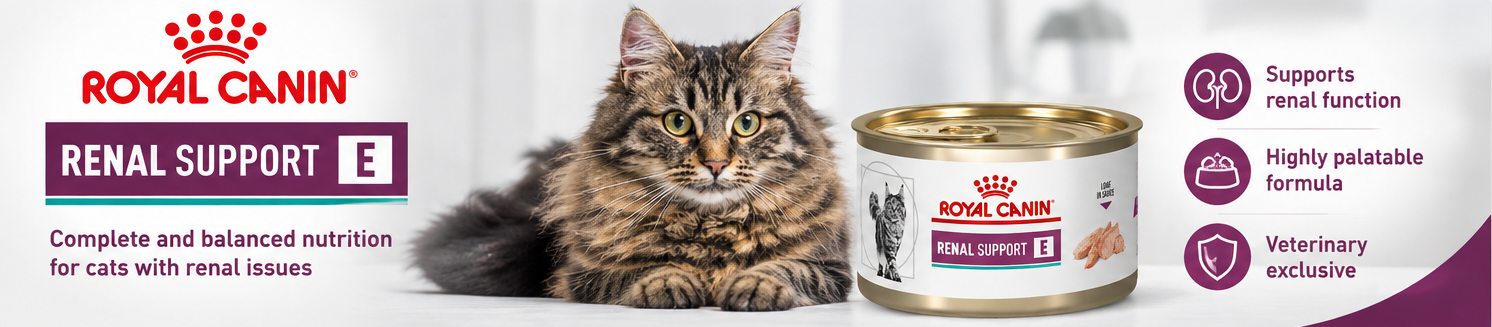
| Royal Canin Veterinary Diet Renal Support (wet) | Prescription | Six options that differ in aroma, texture, shape and size, designed to be mixed and matched | Ask your vet for the dry matter value of the specific variety |
| Royal Canin Renal Support Early Consult (wet) | Prescription | Earlier-stage formula with moderate phosphorus | Confirm the target with your vet |
| Purina Pro Plan Veterinary Diets NF Kidney Function (wet) | Prescription | Early Care and Advanced Care formulas that follow progression | Get dry matter phosphorus from Purina for the exact formula |
| Weruva Wx Phos Focused | Over the counter | Very low phosphorus, popular with picky cats | Recipes list roughly 0.28% to 0.45% dry matter, but the line is intended for intermittent or supplemental feeding |
| Forza10 Active Kidney Renal Support | Over the counter | Fish-based option for cats that dislike chicken | Ask for dry matter phosphorus and whether the label says complete and balanced |
A note on those Hill’s numbers: they come from Hill’s own published nutrient tables, and they sit around 0.5%, not far from the AAFCO adult maintenance minimum. Renal diets are restricted relative to the typical adult food, not dramatically below every food on the shelf. That is why comparing real dry matter values matters more than the word “low”.
How the Brands Differ in Practice
Hill’s k/d is the benchmark many vets reach for first. It comes in more than one texture, and Hill’s markets its appetite-stimulating recipe design. The trade-off is that some cats simply refuse it, and the same cat may accept a different brand without trouble.
Royal Canin Renal Support is built around variety. Instead of one flavor, you get several aromas and textures, and the brand’s own guidance is that you can mix and match them. For a cat that gets bored or nauseated by one smell, that flexibility can be the difference between eating and not eating.
Purina NF is worth asking about if your vet wants a formula matched to stage. The Early Care and Advanced Care versions exist so you do not have to restrict more than necessary early on.
Weruva Wx Phos Focused is the one most owners ask about because it needs no prescription. Treat it as a tool, not a full diet: the manufacturer labels it for intermittent or supplemental feeding. It suits a stable, early-stage cat on a rotation, or a cat that tolerates nothing else for a few days.
Wet Cat Food for Kidney Disease Stage 2: What to Pick
IRIS Stage 2 is mild to moderate kidney disease. Creatinine is mildly raised, many cats still look completely well, and the owner often wonders whether anything needs to change yet. In most cases the answer is yes: this is the stage where vets typically recommend moving to a renal diet, and where it can do the most good.
A stage 2 kidney disease diet has a clear target. IRIS suggests keeping blood phosphorus below about 4.6 mg/dL at this stage, and food is how you get there. For wet cat food for kidney disease stage 2, these are the practical choices:
- Your cat eats almost anything: a prescription pate or stew, fed consistently. You are using the diet while it is easiest to start.
- Your cat is fussy: a brand with several textures and flavors, so you can rotate within renal diets rather than leave them.
- Your bloodwork is borderline between stage 1 and stage 2: ask whether an early-stage formula fits.
- Budget is the limit: ask your vet about a plan that mixes a prescription food with an approved lower-phosphorus option, with bloodwork rechecks. Do not make this swap alone.
Recheck bloodwork about 4 to 8 weeks after any change. If phosphorus is not moving, the food is not doing enough, whatever the label says.
How to Feed It: A Routine That Actually Works
A diet that sits in the cupboard helps nobody. A few habits make wet kidney food easier to live with:
- Transition over one to two weeks, longer for a cat that is nauseated. Start with roughly a quarter new food.
- Warm it slightly. A few seconds in a bowl over warm water brings out the smell. Skip the microwave hot spots.
- Serve small portions several times a day. Fresh food smells stronger and gets eaten more readily.
- Cover and refrigerate opened cans, and follow the label on how long they keep.
- Weigh your cat every week or two on a kitchen or baby scale. Weight loss is often the first sign that food intake is not enough, and it shows up before bloodwork changes.
- Count treats. Many treats are high in phosphorus, so ask your vet which are safe.
When Your Cat Refuses Wet Kidney Food
Nausea is common in kidney disease, and a nauseated cat can develop an aversion to whatever she was eating when she felt sick. That is not stubbornness. If your cat is turning her nose up at everything, tell your vet, because anti-nausea medication or an appetite stimulant often helps more than switching brands. Our guide to cat food for kidney disease that cats will eat goes through flavors, textures and appetite tricks in detail.
If wet food is a lost cause for now, a renal dry diet is far better than a standard dry food. Our review of the best dry cat food for early kidney disease covers what to look for, and you can add warm water or a fountain to close some of the hydration gap.
Common Mistakes When Buying Wet Kidney Food
- Trusting the front of the can. “Kidney support” is not a phosphorus number.
- Ordering a case before a trial. Buy a few cans first, since cats refuse foods unpredictably.
- Rotating through brands too fast. Changing foods every few days can make a nauseated cat more suspicious.
- Using a supplemental food as a whole diet without checking the label.
- Letting a cat go without eating while waiting for her to come around. If she eats little or nothing for more than a day, call your vet.
Conclusion: Choosing the Best Wet Cat Food for Feline Kidney Disease
The best wet cat food for feline kidney disease is the one that meets your vet’s phosphorus target, gives moderate high-quality protein, and gets eaten every day. For stage 2, that usually means a prescription pate or stew, started now rather than later. Check the dry matter numbers, introduce the food slowly, weigh your cat, and recheck bloodwork. For the wider picture, including protein, hydration and stage-by-stage advice, read our complete guide to the best cat food for kidney disease.
FAQ: Wet Food for Cats With Kidney Disease
Is wet food really better than dry for kidney disease? For most cats, yes. The extra moisture supports hydration, which matters because cats with kidney disease lose water through frequent urination. A renal dry diet is still much better than a standard dry food.
Do I need a prescription for kidney wet food? The main renal diets from Hill’s, Royal Canin and Purina require your vet’s authorization. Some lower-phosphorus over-the-counter options exist, but they are often intended for supplemental feeding.
What wet food should I feed at stage 2? Most vets recommend starting a renal diet at stage 2. A prescription pate or stew is the usual choice, and your vet may suggest an early-stage formula if bloodwork is borderline.
How do I know if a wet kidney food is working? Bloodwork. Phosphorus and other values should move toward your vet’s targets within about 4 to 8 weeks, and your cat’s weight and appetite should stay steady.
Can I mix prescription and non-prescription wet food? Sometimes, if your vet agrees and monitors bloodwork. Do not combine them on your own.
How long does an opened can last? Cover and refrigerate it, and follow the storage guidance on the label. When in doubt, throw it out.
What if my cat will not eat any wet kidney food? Call your vet. Options include a different brand, flavor or texture, anti-nausea medication, an appetite stimulant, or a renal dry diet while you work on wet food.