Can Cats See in the Dark? The Truth Behind Feline Night Vision
When your cat gracefully navigates a pitch-black room without stumbling, it’s easy to believe they possess superhuman abilities. The mythology surrounding feline eyesight has persisted for centuries, often portraying cats as creatures of pure darkness with supernatural visual prowess. But the reality is far more fascinating—and far more grounded in biology. The answer to whether cats truly see in complete darkness might surprise you.
Table of Contents
Debunking the Myth of “Total” Night Vision
Let’s address the elephant in the room immediately: can cats see in the dark with perfect clarity? The honest answer is no. Your feline companion cannot navigate 100% darkness any better than you can. In absolute blackness, both cats and humans are equally blind. This fundamental truth serves as the foundation for understanding feline vision accurately.
What separates cats from humans isn’t the ability to see in pure darkness—it’s their exceptional efficiency in low-light environments. Cats are not strictly nocturnal creatures, despite popular assumption. Instead, they’re crepuscular, meaning they’re most active during dawn and dusk when twilight offers minimal but usable light. This adaptation developed through millions of years of evolution as their wild ancestors hunted small prey during these transitional periods.
The efficiency standard is where cats genuinely excel. Your cat requires only one-sixth of the light that you need to see effectively. This single statistic explains why your pet moves with such confidence during evening hours while you’re fumbling for a light switch. Understanding this difference between “seeing in darkness” and “seeing better in low light” is crucial for grasping how feline vision truly operates.
The Anatomy of Feline Vision: Why It Works
The mechanics behind feline visual superiority begin with their eye structure, which is fundamentally engineered for low-light performance. The large lens and curved cornea work together as sophisticated light-capturing instruments. These features are significantly more pronounced in cats than in humans, allowing them to gather and utilize every photon of ambient light available.
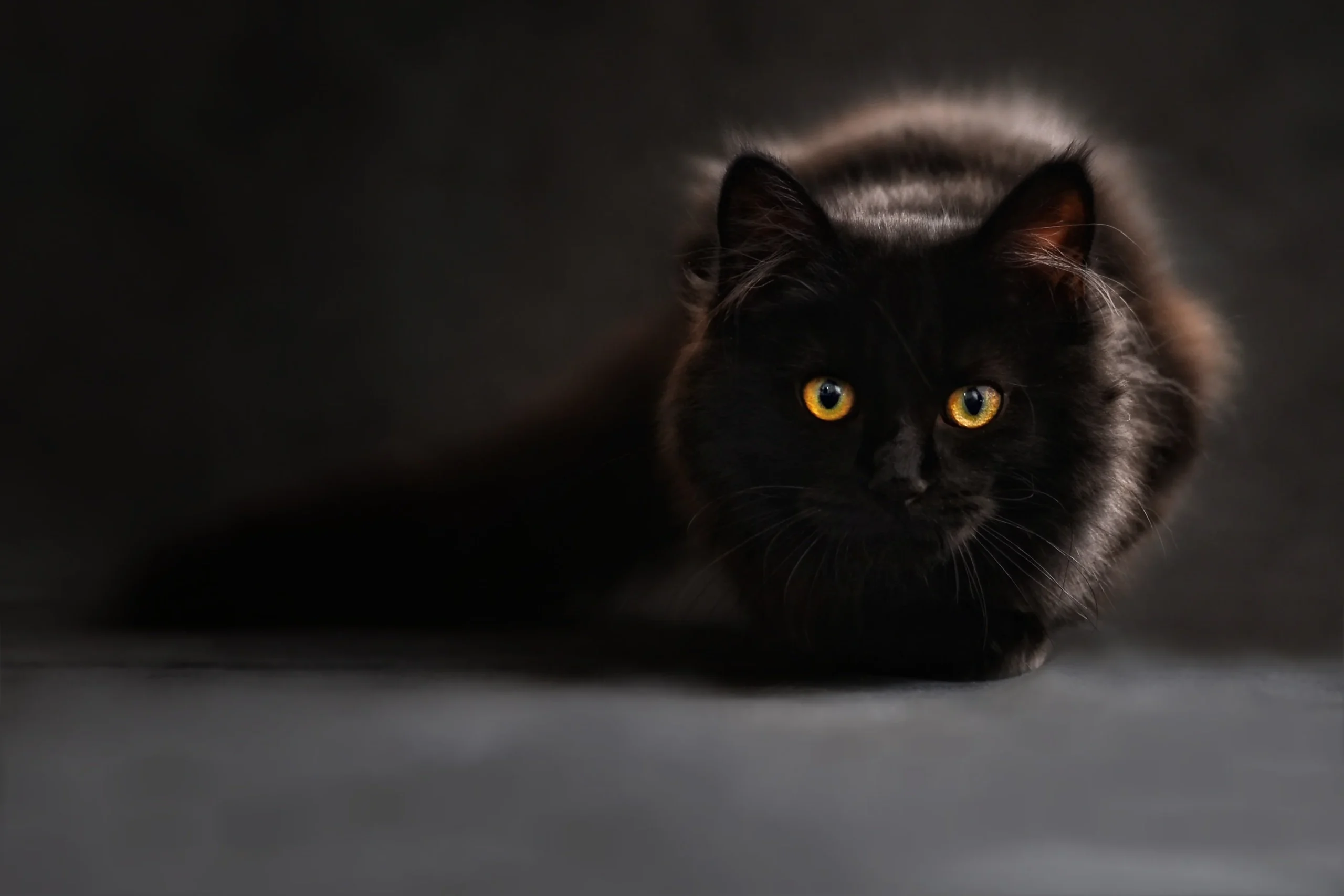
Behind the retina lies one of nature’s most ingenious adaptations: the tapetum lucidum. This reflective layer functions like a biological mirror, bouncing light back through the photoreceptors for a second opportunity at absorption. Think of it as a safety net for light particles that initially pass through without being detected. This “mirror effect” is precisely why your cat’s eyes appear to glow eerily when illuminated by flashlights or car headlights—the light is reflecting back toward the source rather than being fully absorbed.
The photoreceptor composition in feline eyes reveals another crucial adaptation. Cats possess approximately 96% rod cells dedicated to light and motion detection, with only 4% cone cells responsible for color vision. This ratio is the inverse of human eyes, which prioritize color perception and daytime clarity. For an animal hunting in dim conditions, this trade-off makes perfect evolutionary sense.
Pupil dynamics further enhance feline night vision capabilities. A cat’s pupil can expand up to 300 times its smallest diameter, compared to the human pupil’s 15-fold expansion capability. This dramatic difference means cats can allow substantially more light to enter their eyes, maximizing the use of every available photon during twilight and nighttime hours.
Visual Capabilities: Feline “Superpowers”
Beyond low-light adaptation, cats possess several visual abilities that truly qualify as superpowers in the animal kingdom. Their motion sensitivity is legendary—they can detect minute movements that human eyes would miss entirely. This exceptional motion detection evolved specifically for hunting, allowing cats to track scurrying prey with laser-focused precision.
The expanded field of view is another significant advantage. While humans enjoy a 180-degree field of vision, cats achieve an impressive 200-degree peripheral vision. This wider perspective helps them monitor their environment for potential threats and prey opportunities simultaneously.
Recent scientific evidence suggests cats may perceive ultraviolet light, a spectrum entirely invisible to human vision. Many rodents and insects leave ultraviolet markings in their urine trails, creating illuminated highways visible only to creatures with UV-sensitive eyes. If confirmed, this capability would represent a profound hunting advantage invisible to our understanding.
Navigation by contrast is perhaps the most underappreciated aspect of feline night vision. Contrary to assumptions about perfect clarity, cats actually rely heavily on shadows, contrast, and movement rather than sharp detail. Their brains process these contrast patterns to construct a functional mental map of their surroundings, allowing smooth navigation even when humans would feel completely disoriented.
The Trade-offs: Limitations of Cat Vision
The evolutionary specialization toward night vision comes with notable trade-offs. Cats are red-green color blind, perceiving the world primarily through shades of blue, yellow, and grey. While this might seem limiting, it matters little for nocturnal hunting, where color detection is far less crucial than motion and contrast sensitivity.
Feline vision is also fundamentally mid-sighted. Cats struggle to focus on objects extremely close to their face, which is why they famously use their whiskers to navigate near their nose. At the opposite extreme, their visual clarity diminishes significantly beyond approximately 20 feet, whereas human vision remains sharp up to 100 or even 200 feet. This sweet spot for feline focus reflects their evolution as close-range hunters rather than long-distance predators.
Overall image resolution represents another compromise. While cats excel in low light, their overall visual acuity and sharpness is noticeably lower than human vision. The trade-off between light sensitivity and image clarity is fundamental to how eyes work—optimizing for one naturally compromises the other.
Lifecycle and Biological Variations
Feline vision undergoes dramatic changes throughout a cat’s life. Kittens are born completely blind, with functional night vision developing gradually between 8 and 12 weeks of age. This developmental timeline reflects the complex neural pathways required for sophisticated visual processing.
Senior cats experience declining vision as they age. Retinal degeneration, reduced pupil flexibility, and increased light sensitivity all contribute to vision loss in older felines. These changes sometimes necessitate environmental adjustments to help aging cats navigate safely.
An interesting exception exists in blue-eyed cats, whose eyes glow red rather than green under light. This coloration difference suggests abnormal cells in their tapetum lucidum, potentially compromising night vision quality compared to their green-eyed counterparts.
Conclusion and Practical Application
The study of cat vision has profoundly influenced human safety innovations. Reflective road studs, inspired by the tapetum lucidum’s light-reflecting properties, have saved countless lives by improving nighttime visibility on roadways. This biological inspiration demonstrates how understanding nature’s solutions yields practical applications.
For cat owners, supporting feline vision at home involves simple strategies. Motion-activated night lights help senior cats navigate safely without creating glare that might overwhelm their sensitive eyes. Understanding your cat’s visual strengths and limitations enables you to create an environment where they naturally thrive.
Your cat’s remarkable night vision represents millions of years of evolutionary refinement—not supernatural powers, but rather elegant biological engineering perfectly suited to their hunting heritage. While they cannot see in absolute darkness, their ability to function in minimal light remains one of nature’s most impressive visual adaptations.